
Injection molding capacity planning starts with a deceptively simple question: which press should run this tool, and when? The useful answer depends on more than clamp force. Demand pattern, cavity count, shot size, cycle time, material handling, automation, changeover time, quality requirements, maintenance windows and schedule protection all affect whether a press is genuinely available for a program. A nominal machine list is not the same as demonstrated capacity.
This guide is for product, operations, engineering and procurement teams comparing a supplier's press allocation proposal. It explains how to turn a forecast into a transparent capacity model, challenge optimistic utilization assumptions and decide when a primary press, alternate press or second-source plan is appropriate. Treat the examples as planning methods rather than guarantees; the final fit must be confirmed against the specific mold, resin, machine and customer requirements.
Ask for a capacity model that shows the tool, cycle, cavities, effective hours, planned downtime, changeovers and recovery margin—not only the press tonnage and a monthly part number.
01
1. Convert the forecast into a press-hour requirement
Begin with demand by period rather than one annual total. Separate launch demand, steady-state demand, seasonality, engineering builds, service parts and plausible upside. Then state whether the quantity is good parts, total shots or molded components before scrap and rework. These definitions matter because a four-cavity tool producing 10,000 good parts is not the same workload as 10,000 machine cycles.
A simple first-pass calculation is: required press hours = (required good parts ÷ cavities ÷ 3600) × cycle time ÷ expected yield, with setup, changeover, inspection, planned maintenance and contingency added separately. Use seconds consistently and make the yield assumption visible. The calculation is a screening model, not a promise: cycle time may change with mold temperature, cooling, part handling, resin drying, operator intervention or a quality hold.
Ask the supplier to show the source of each input. A historical cycle from another machine may be a useful starting point, but it is not demonstrated capacity on the proposed press. InjeForm's [process](/process) and [request-a-quote](/request-a-quote) routes can help structure the input package: part model or drawing, material direction, cavity count, expected volume, delivery pattern and known quality gates.
02
2. Check that the tool and press are physically compatible
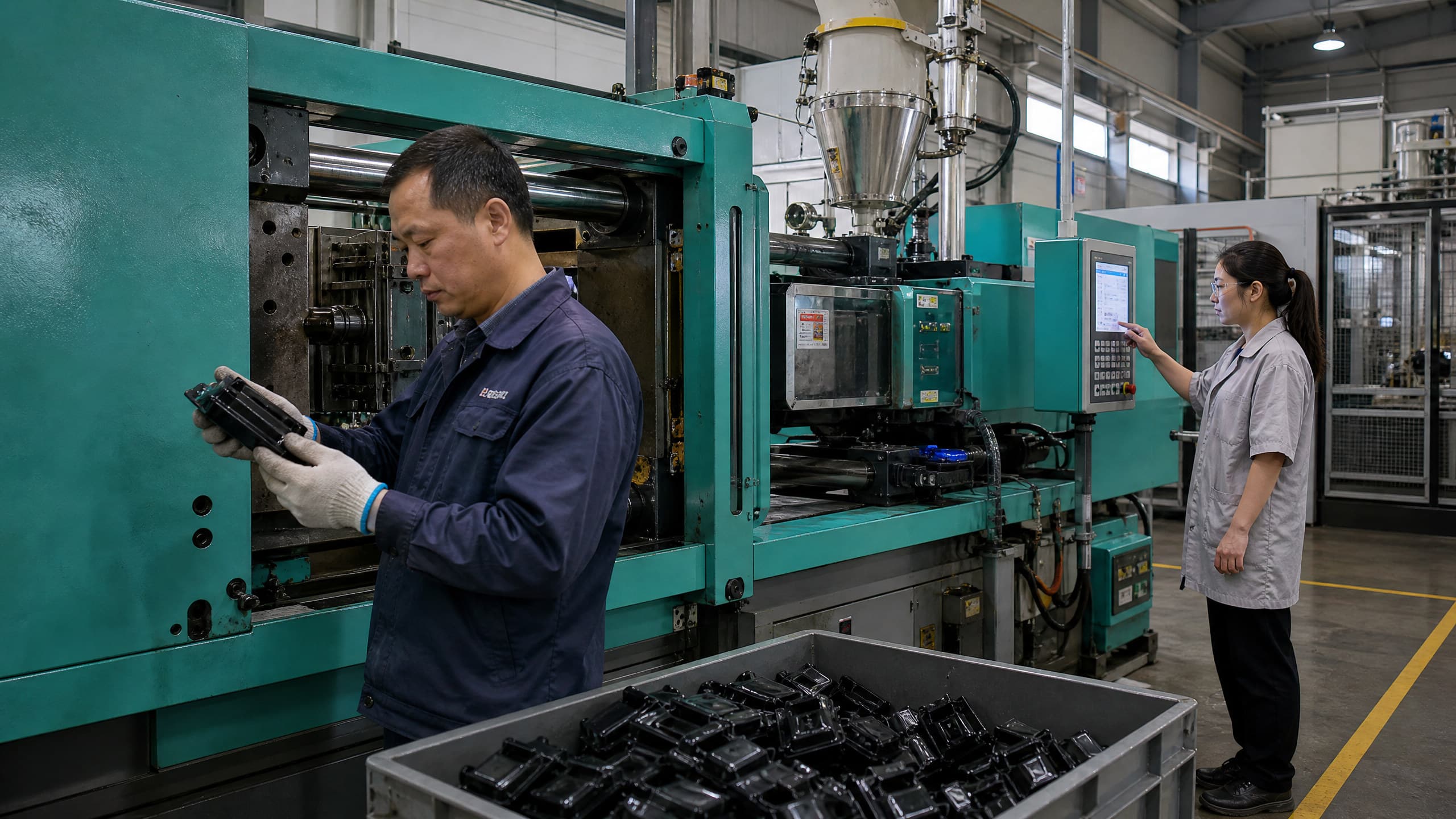
Clamp force is only one screen. Confirm mold height and daylight, platen dimensions, tie-bar spacing, locating-ring and sprue-bushing compatibility, ejector stroke, nozzle reach, maximum injection pressure, shot size, screw diameter, plasticizing rate, temperature-control connections and any robot or insert-loading envelope. A press can have enough nominal tonnage and still be a poor fit for the tool or process.
Shot size deserves particular care. Compare the required shot—including runner or hot-runner volume where applicable—with the machine's usable shot range for the selected resin, not merely the catalog maximum. A very small shot on a large machine can create control or residence-time questions; an undersized machine can constrain fill speed, pressure or recovery. The toolmaker, molder and product team should agree which values are calculated, which are machine-rated and which must be confirmed in a trial.
For large, thin-wall, filled or appearance-critical parts, ask how the allocation accounts for injection speed, pressure, thermal control, venting and warpage risk. For insert molding, overmolding or automated loading, include the actual sequence and safety envelope. Equipment compatibility should be confirmed through documented review and trial evidence rather than inferred from a press nameplate.[1]
| Allocation check | What to compare | Buyer evidence to request |
|---|---|---|
| Clamp and mold fit | Required clamp force, mold height, daylight, platen and tie-bar envelope | Machine model, mold outline, clamp-force basis and fit confirmation |
| Injection and shot | Shot weight, usable shot range, injection pressure, speed and recovery | Part-plus-runner calculation, resin basis and machine setting limits |
| Thermal control | Barrel, mold-temperature and cooling requirements | Controller capacity, cooling approach and trial observations |
| Automation and handling | Robot reach, inserts, take-out, inspection and operator steps | Cycle sequence, interface assumptions and safety review |
| Quality risk | Appearance, dimensions, cavity balance and process-window sensitivity | Trial plan, measurement method and escalation criteria |
03
3. Allocate by effective capacity, not catalog capacity
A supplier's installed tonnage is a capability indicator, not an available-hours figure. Effective capacity should subtract planned maintenance, holidays, setup and mold changeovers, qualification trials, material or color purges, inspection holds, staffing constraints and expected unplanned downtime. A press running at a theoretical 24 hours per day may look attractive in a spreadsheet while being unavailable when the program actually needs it.
Use an explicit utilization assumption and test a range. For example, calculate the program at a base case, a slower cycle, a reduced yield and a disruption case. Do not hide every risk inside one broad efficiency percentage; separate the drivers so the buyer can see which assumption changes the result. Capacity planning guidance commonly treats availability, performance and quality as distinct contributors to productive output rather than equating scheduled time with good-part capacity.[2]
Reserve margin should be tied to the consequence of missing demand. A launch with a fixed customer date may need more protected hours or an alternate press than a replenishment part with inventory coverage. Conversely, reserving a large block indefinitely can create cost and opportunity risk. Ask how the supplier releases unused reservations, reprioritizes urgent work and communicates when the original capacity case no longer holds.
04
4. Compare press-allocation options with a decision matrix
A good allocation conversation compares options, not just the supplier's preferred machine. The smallest compatible press may improve energy and utilization, while a larger or newer press may offer more process headroom or automation capacity. A duplicate press may reduce single-point exposure but add qualification and setup work. The right choice depends on part risk, demand volatility, schedule consequences and the evidence available.
Use the following matrix as a review aid. It does not replace a machine-specific fit study or product-owner approval. If a part has multiple high-risk characteristics, use the stricter review path and document why.
For a new program, ask the supplier to identify the proposed primary press, an alternate press if one exists, the conditions under which the alternate could be used, and what evidence would be repeated after a press change. Link the answer to your [quality](/quality) expectations and to the release plan rather than accepting an unqualified statement that any press in the same tonnage range is equivalent.
| Allocation option | When it may fit | Main buyer question | Release evidence |
|---|---|---|---|
| Smallest compatible press | Stable geometry, validated process and routine demand | Is there enough pressure, shot and schedule margin? | Fit review, stable trial and CTQ comparison |
| Larger press with headroom | Difficult filling, larger mold or automation constraints | Could low shot utilization, residence time or energy offset the headroom? | Usable-shot review, process-window trial and quality data |
| Dedicated primary plus qualified alternate | Business-critical part or variable demand | What changes when the tool moves, and who authorizes the move? | Alternate-press trial, setup record and re-release criteria |
| Shared press pool | Several compatible tools with flexible sequencing | How are changeovers, purges and priority conflicts scheduled? | Finite schedule, changeover standard and capacity review |
| Split across two presses or sites | High volume, continuity need or regional supply strategy | Can parts remain equivalent and traceable across sources? | Part-to-part comparison, lot segregation and source approval |
05
5. Plan changeovers, maintenance and quality gates as capacity events
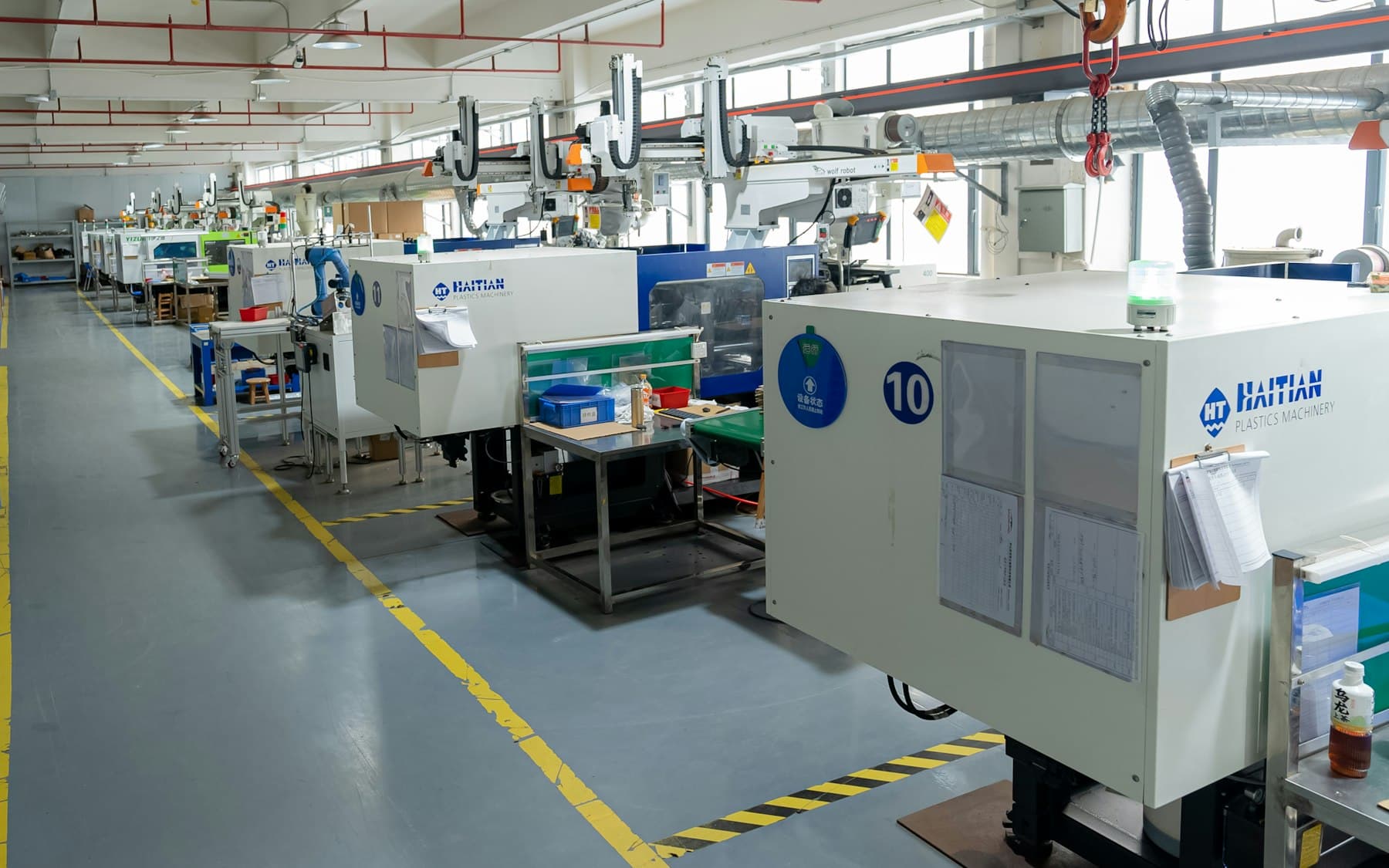
Capacity is consumed by the work around molding as well as by steady-state cycles. Include mold installation, connection checks, dry runs, material loading, purging, color changes, first-off inspection, sampling, packaging and teardown. A multi-cavity or cosmetic tool may require longer verification than a simple single-cavity part. If the supplier quotes only run time, ask where these activities appear in the schedule and cost model.
Maintenance should be planned rather than treated as an unexpected deduction. Ask how preventive maintenance, mold cleaning, dryer service, robot checks and press calibration or verification are scheduled against the program. A planned maintenance window can be less disruptive than a failure, but only if the hours are visible and production recovery is realistic. Do not infer machine condition or uptime from a press list alone.
Quality holds are also capacity events. Define who can stop a run, how samples are identified, what happens to material made during an investigation and how quickly disposition decisions are expected. For regulated or safety-relevant products, use the product owner's validation and documentation requirements. General OEE-style metrics can help structure discussion, but they do not establish that a particular part is capable or approved.[3]
06
6. Protect the plan against demand change and press disruption
A capacity plan should say what happens if demand rises, falls or moves in time. For upside demand, identify the next compatible press, additional shift, cavity expansion, second tool or alternate site, along with the qualification lead time and commercial trigger. For downside demand, clarify whether reserved hours can be released and whether minimum batch sizes or changeover economics change. This turns a forecast into an operating agreement rather than a one-time spreadsheet.
Build a simple disruption scenario. Consider press breakdown, mold repair, resin shortage, operator absence, utility interruption, delayed approval and a quality hold. For each, record detection, containment, decision owner, available recovery hours and customer communication route. Business-continuity planning is strongest when it names dependencies and recovery actions instead of relying on a generic statement that capacity is available.[4]
Before award, request a concise allocation sheet showing the primary press, alternate capability, effective hours, demand assumptions, changeover time, planned downtime, contingency, open compatibility questions and review date. InjeForm's [capabilities](/capabilities), [faq](/faq) and [request-a-quote](/request-a-quote) routes are useful starting points for clarifying process scope; the final allocation should remain specific to the approved tool, material and part revision.

Practical takeaway
Before you move
to the next review.
- The forecast is split by period, good parts, launch or repeat demand, seasonality and plausible upside or downside.
- Press-hour math identifies cavities, cycle time, yield, setup, changeover, inspection, maintenance and contingency assumptions.
- The proposed press is checked for mold envelope, clamp force, shot size, pressure, speed, recovery, temperature control and automation fit.
- Effective capacity is separated from catalog capacity, with utilization and downtime drivers shown rather than hidden in one percentage.
- Primary and alternate press options are compared with explicit qualification and release evidence after a press change.
- Changeovers, purges, first-off approval, quality holds, preventive maintenance and packaging are included in the schedule.
- Upside, downside and disruption scenarios identify owners, recovery actions, communication triggers and review dates.
FAQ
Common questions
Is press tonnage enough to decide whether a machine can run my injection mold?
No. Tonnage is an important first screen, but mold envelope, tie-bar spacing, daylight, shot size, injection pressure and speed, temperature control, ejection and automation can also determine fit. Ask for a machine-and-tool compatibility review and confirm the assumptions in a controlled trial.
How should buyers calculate injection molding capacity?
Start with good-part demand, cavity count and cycle time, then account for expected yield, setup, changeovers, inspection, planned maintenance and available schedule hours. Show each assumption separately and test slower-cycle, lower-yield and disruption cases. The result is a planning estimate, not a guaranteed output.
Should a supplier reserve a dedicated press for my program?
It depends on demand stability, part criticality, schedule consequences and the supplier's changeover model. A dedicated press may protect a fixed launch or difficult process, while a qualified shared pool may be more efficient for variable demand. Define how unused reservations, priorities and alternate presses will be handled.
Can the same mold move to another press without requalification?
Do not assume equivalence from tonnage alone. A press change can alter injection, thermal, ejection, automation or process-window conditions. The product owner and quality team should define a risk-based confirmation or requalification plan, with documented setup, sample comparison and release criteria.
What capacity evidence should I request before awarding an injection molding program?
Request the proposed machine model and fit review, cavity and cycle assumptions, effective-hours calculation, changeover and downtime allowances, primary and alternate capability, planned maintenance approach, quality-gate timing and a disruption response. Ask the supplier to identify which values are demonstrated and which remain estimates.
References
Source material
- [1] ISO, “ISO 20430:2020 — Plastics and rubber machines — Injection moulding machines — Safety requirements.”
- [2] U.S. Department of Energy, “Improving Production Efficiency Through Total Productive Maintenance.”
- [3] NIST Manufacturing Extension Partnership, “Manufacturing Metrics: Measures of Success.”
- [4] NIST Manufacturing Extension Partnership, “Business Continuity Planning.”
This guide is general information for early procurement and engineering discussion. It does not replace product-specific DFM, qualification, validation, regulatory assessment or legal advice.