
Buyers should run a factory acceptance test (FAT) for an injection mold as a documented decision gate, not a showroom demonstration. Approve a written protocol before the run, witness or review the agreed operating conditions and full evidence set, then accept, conditionally release, or reject the tool against pre-agreed criteria. The injection mold T1 sample is useful evidence, but a single attractive sample is not injection mold validation. A credible decision connects the drawing revision, resin, machine conditions, cavities, inspection method, functional checks, deviations, and corrective-action ownership. FDA validation guidance similarly treats a written protocol, defined data, acceptance criteria, sampling plan, deviations, and an approved concluding report as essential controls [1].
Ready to structure a project-specific injection mold trial? Send the 3D model, drawing, resin specification, critical-to-quality requirements, annual demand, and acceptance priorities through our request-a-quote channel so the trial scope can be aligned before tool build.
01
Set the FAT outcome before anyone schedules the injection mold trial
The buyer’s first task is to define what the FAT can decide: accept the mold for the next phase, accept it subject to listed non-critical actions, require another trial, or stop for a critical issue. Do not substitute ‘looks good’ for a signed disposition and dated action log.
Separate tool-function acceptance, part acceptance, and process readiness. Tool-function acceptance covers opening, closing, feeding, venting, ejection, cooling, and cycling. Part acceptance covers drawing, appearance, assembly, and function. Process readiness asks whether the documented window can make conforming parts repeatedly. A T1 sample can support one decision without closing all three.
For an export injection mold, name release authorities and deviation approvers. When travel is impractical, define remote witness views of the press interface, mold movement, ejection, cavity ID, measurement setup, and a live evidence review. Remote participation works only when the evidence is traceable.
02
Build a buyer-owned FAT protocol
Issue a concise protocol before the trial and freeze the engineering revision. Attach the 2D drawing, 3D model revision, resin grade and color, appearance standard, fixtures, cavity plan, and special requirements. Identify critical-to-quality characteristics by datum and inspection method.
Specify the planned press, temperature control, resin preparation, part handling, and approved process ranges. Record actual conditions; do not impose a universal setting. Material lot, drying controls, permitted regrind, and colorant should be traceable because they affect dimensional and cosmetic results.
Define the sampling plan before the press starts: cavities, set-up and stabilized samples, time points, measurement method, functional fixture, and photos. FDA guidance recommends that a protocol identify conditions, data, tests, acceptance criteria, sampling, statistical approach, and deviation handling [1]. Apply product-specific obligations for the buyer’s market and sector.
03
Witness the run without confusing adjustment with validation
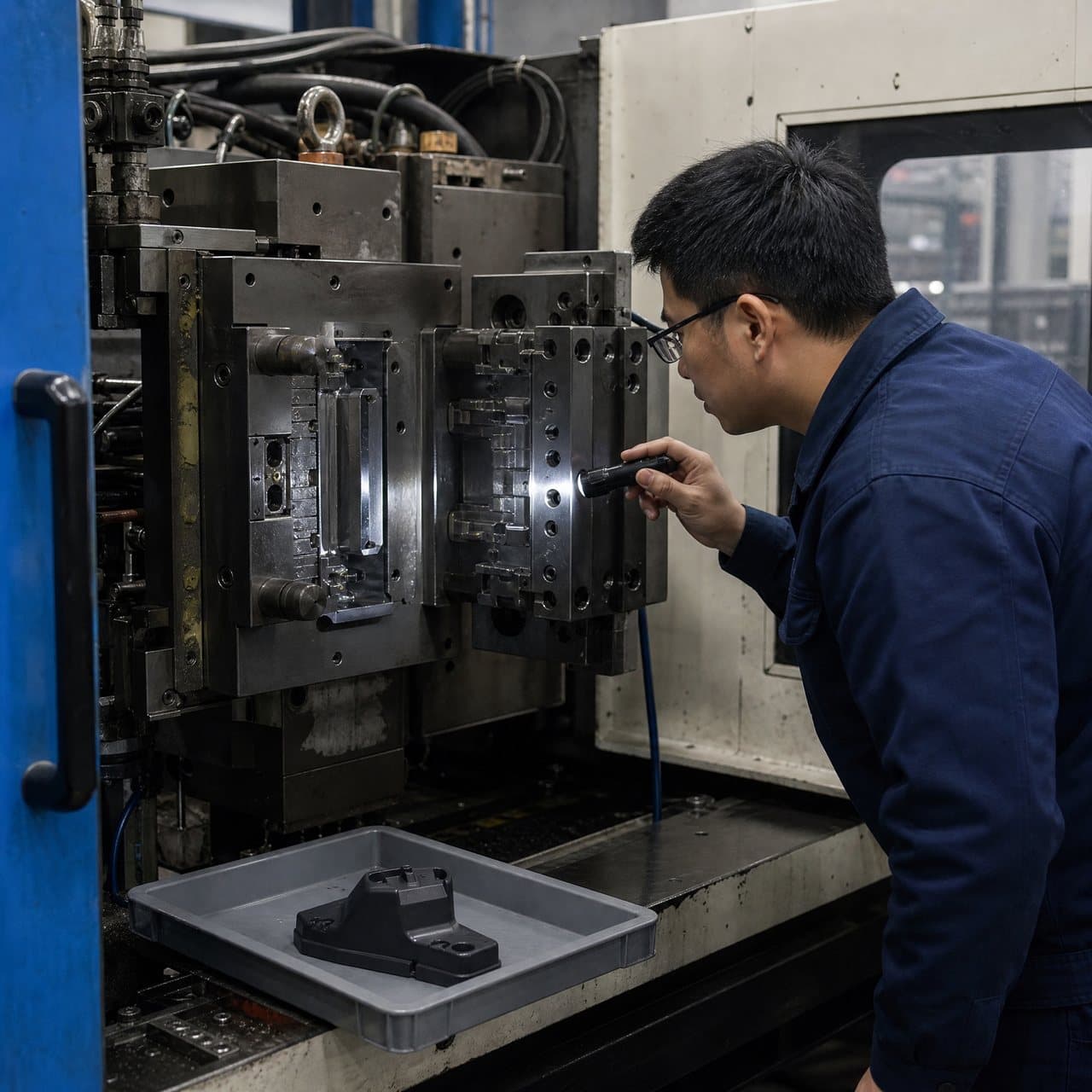
At the trial, verify mold ID, revision, cavity count, inserts, date marks, safety features, resin, press, and auxiliary equipment. Observe protection, molding, cooling, ejection, removal, runner handling, leaks, and interference. Record every setting change, its reason, authorization, and the samples made before and after it.
Request samples that show cavity-to-cavity and time-related variation, not only the best cavity. Keep stabilized-run samples separate from early set-up parts. Sample quantity and timing depend on risk, cavity count, part geometry, material behavior, inspection burden, and contract requirements; any number is a project-specific example, not a universal rule.
Use the following evidence matrix as a starting point. The example language is deliberately conditional; the drawing, approved visual standard, and buyer’s risk assessment must supply the actual thresholds.
| Evidence block | Buyer verifies | Project-specific example acceptance statement | Disposition |
|---|---|---|---|
| Tool function | Opening, closing, ejection, slides, cooling connections, leaks and safety | All agreed functions complete without observed interference during the witnessed run | Pass / action / fail |
| Process record | Actual resin, material lot, drying record, press and auxiliary IDs, settings and changes | Recorded conditions are within the approved trial window or carry an approved deviation | Pass / action / fail |
| Cavity evidence | Cavity ID, sample traceability and cavity-to-cavity comparison | Each required cavity has traceable sample and inspection evidence | Pass / action / fail |
| Part conformance | CTQs, dimensions, mass where relevant, appearance and functional fit | Results meet drawing and approved acceptance criteria using stated methods | Pass / action / fail |
| Corrective actions | Issue description, containment, owner, due date and re-verification route | No unresolved critical item remains before the agreed release | Pass / action / fail |

04
Require an injection mold trial report that can support a release decision
An injection mold trial report should be an auditable record. Include buyer program and tool IDs; drawing and CAD revisions; date and attendees; press, auxiliaries, material, sample IDs, cavities tested, and protocol revision. Link raw photos, measurement files, functional observations, permitted process captures, and a cavity map.
For every requirement, show the nominal, tolerance or acceptance rule, method, result, sample and cavity ID, status, and evidence reference. Confirm that the method can resolve the tolerance. NIST distinguishes repeatability, reproducibility, stability, bias, and uncertainty, and includes Gauge R&R for assessing measurement-system variation [2]. A close result is weak evidence if the gauge, fixture, or operator method cannot distinguish conforming from nonconforming parts.
Each deviation needs its symptom, affected cavity or sample, containment, proposed change, owner, date, and re-test requirement. Conclude against the protocol: what passed, what failed, missing data, and what permits or blocks the next phase. FDA guidance calls for reports to assess adherence, analyze data and nonconformances, describe corrective actions, and reach a clear conclusion [1].
05
Make injection mold acceptance a controlled commercial handoff
Use a signed acceptance record that distinguishes physical tool acceptance from approval to make production parts. Record the accepted configuration, open items, temporary limits, evidence needed to close each action, and re-approval triggers. A steel adjustment, gate change, texture repair, insert replacement, or press move may require another review.
Secure the agreed handoff package: controlled tool drawings, major-component list if contracted, spare-part list where applicable, maintenance and preservation instructions, parameter record, inspection report, sample-retention rule, and shipping or storage condition. ISO presents its quality-management family as grounded in customer focus, a process approach, and continual improvement [3]. Preserve evidence without assuming any supplier certification.
For Europe, the United States, and the Middle East, align the protocol with the purchase order, destination requirements, record language, remote-witness time zone, and responsibility for independent inspection. Obtain appropriate sector and legal review for safety-, medical-, automotive-, or food-contact-critical requirements. Commercial release should follow evidence, not reconstruct it after shipment.
Practical takeaway
Before you move
to the next review.
- Freeze the drawing, CAD, cosmetic standard, resin grade, color, CTQs, and acceptance protocol before the injection mold trial date.
- Name buyer and supplier release authorities, remote-witness arrangements if used, and the approval route for deviations or setting changes.
- Verify the injection mold ID, configuration, cavity count, inserts, press and auxiliary equipment, material lot, and sample traceability at the start of the run.
- Separate set-up parts from stabilized-run samples and collect cavity-identified evidence at the project-specific sampling points.
- Review dimensions, cosmetic zones, mass where relevant, assembly or functional tests, and measurement-method suitability against the agreed acceptance criteria.
- Require an injection mold trial report with raw evidence links, actual conditions, results, deviations, corrective actions, owners, dates, and a clear conclusion.
- Do not sign injection mold acceptance with unresolved critical risks; document any conditional release and the exact re-verification evidence needed.
- Archive the accepted configuration, controlled process record, maintenance or preservation instructions, and the agreed tool handoff documents.
FAQ
Common questions
Is an injection mold T1 sample enough for injection mold acceptance?
Usually no. A T1 sample can show that a tool produces parts, but acceptance should cover the agreed scope: tool function, traceable material and conditions, cavity evidence, dimensional and cosmetic checks, functional requirements, deviations, and signed disposition. A buyer can release a limited next step while reserving final production approval for further evidence.
What should an injection mold trial report include?
Include tool and engineering revisions; date and attendees; press, auxiliary equipment, material and sample IDs; actual settings and changes; cavity map; inspection and functional results; raw-evidence references; deviations; corrective actions; owners; dates; and an acceptance conclusion. Match each result to the agreed requirement and method.
How many samples are needed for injection mold validation?
There is no responsible universal number. Define quantity and timing from risk, cavity count, part complexity, critical characteristics, material behavior, intended production conditions, and contract or sector requirements. Document the project-specific rationale and any departure.
Can a buyer conduct an injection mold trial remotely?
Yes, when the protocol defines live views and evidence controls. Use camera views of mold and press, cavity and sample IDs, prompt raw-record sharing, and a live review. Do not use remote observation to replace independent inspection or physical sample review where the purchase order or risk profile requires them.
References
Source material
- [1] U.S. Food and Drug Administration, Process Validation: General Principles and Practices
- [2] NIST/SEMATECH e-Handbook of Statistical Methods, Measurement Process Characterization
- [3] International Organization for Standardization, ISO 9000 family — Quality management
This guide is general information for early procurement and engineering discussion. It does not replace product-specific DFM, qualification, validation, regulatory assessment or legal advice.