
An injection molding supplier should seek PPAP resubmission, or the customer’s written disposition, whenever an engineering, material, tooling or process change can affect the approved design record, product characteristics, production route or agreed inspection evidence. The correct response is not to assume that every change requires a complete package. It is to notify the customer before implementation, assess what the approved PPAP covered, and obtain a documented decision on full resubmission, partial evidence, interim approval or waiver [1] [2].
Treat PPAP approval as approval of a defined part-and-process baseline. If that baseline changes, ask the customer’s quality or supplier-engineering contact to confirm the required evidence and effective date in writing. This guide is general information; customer-specific requirements and contracts control.
01
Start with the approved baseline, not the change label
Before deciding whether to resubmit, identify what the original approval actually covered. Record the part number, drawing and CAD revision, material grade and colour, tool and cavity context, production location, process route, inspection method, packaging assumptions and any customer-specific requirements. AIAG describes PPAP as a process for demonstrating that engineering design records and specification requirements are achieved by the supplier’s manufacturing process [1]. That means the meaningful question is whether the proposed change could alter the approved evidence or the customer’s acceptance decision.
A small change in a drawing note may have little practical effect, while a seemingly narrow change to a gate, resin grade or inspection fixture may affect a critical characteristic. Do not classify a change as minor only because its engineering-change number is small. Link the change description to affected features, risks, controls and records, then let the customer determine the required submission route.
| Change or event | Initial buyer-supplier question | Possible customer disposition |
|---|---|---|
| Engineering change | Does geometry, tolerance, interface, appearance or function change? | Affected-feature evidence, partial PPAP or full resubmission. |
| Material or grade change | Does resin family, grade, filler, colour, additive or recycled content change? | Material approval and validation, updated records or new PPAP. |
| Tooling repair or modification | Could the repair alter cavity geometry, cooling, gate, ejection or part consistency? | Repair report, re-sampling, dimensional evidence or resubmission. |
| Process or location change | Does the route, machine, parameter window, subcontractor or plant change? | Trial evidence, updated controls, interim approval or PPAP. |
| Inspection or packaging change | Could the method, fixture or pack-out change the acceptance or delivered condition? | Method approval, correlation evidence or customer waiver. |

02
Engineering changes usually require a new approval decision
An engineering change should be routed to customer approval when it changes a design record, specification, critical characteristic, mating interface, cosmetic requirement or intended function. Examples include a wall change near a sealing face, a revised boss or datum, a new draft condition, a moved gate, a tolerance revision or a change to a safety- or regulatory-relevant feature. The supplier should provide the old and proposed revisions, rationale, affected characteristics and implementation plan before making production parts to the new baseline.
The evidence should be proportional to the affected risk. A feature-level change may call for an updated ballooned drawing and dimensional results for affected and linked characteristics. A structural or functional change may need updated risk analysis, process controls, capability or validation evidence as agreed. AIAG’s PPAP training material identifies submission requirements and part-approval records as core activities, but it does not make a universal submission level for every customer or change [1].
03
Material changes and tooling repair need impact evidence
A material change is not limited to switching from one polymer family to another. A different grade, supplier, filler level, colourant, additive package, recycled-content percentage or approved substitute can affect shrinkage, flow, stiffness, appearance, chemical resistance or processing windows. The product owner should define which properties matter. The supplier should identify the new material, lot or grade documentation available, affected process settings and the checks proposed to demonstrate continued conformity. Do not describe an alternative resin as equivalent without a customer-approved basis.
Tooling repair is similarly conditional. Replacing a worn ejector pin may have no intended design change, but welding and re-machining a cavity, altering a gate, changing cooling, adding steel, polishing a cosmetic surface or reworking a shutoff can affect the molded part. Document the repair location, reason, before-and-after condition, verification plan and first production run identity. The customer can then decide whether the repair is internal maintenance, a controlled change with partial evidence or a PPAP resubmission trigger.
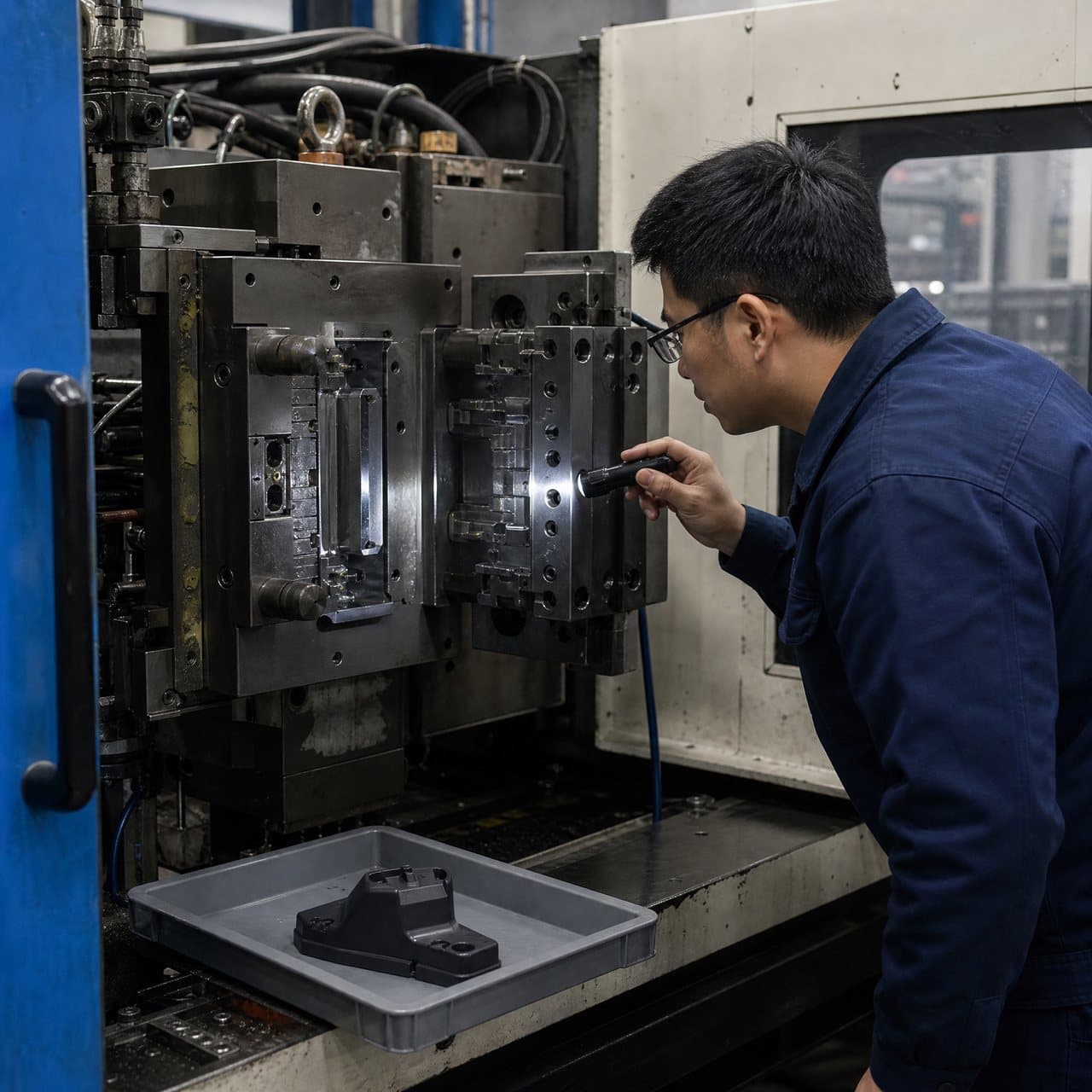
Use the visual assets in this guide only as illustrative manufacturing context. They do not show an approved PPAP package, a customer part, a validated process or a particular tooling repair.

04
Process changes should be notified before implementation
A process change can include a new press, changed automation, a different cycle or parameter window, a new mold location, a subcontracted operation, a changed regrind practice, a revised inspection method or a transfer to another production site. The key question is whether the change can influence product characteristics, repeatability, traceability or the conditions represented by the original approval. A production trial may be appropriate, but a trial is evidence for a decision rather than permission to ship by itself.
Prepare a concise change notice with the current and proposed process, reason, timing, affected part numbers and cavities, containment plan, verification results and requested customer disposition. For changes that touch control plans or risk analysis, update those documents and explain why unaffected controls remain valid. Customer-specific requirements can add stricter notification or approval steps; for automotive programmes, the applicable OEM and contract requirements should be checked alongside the general PPAP framework [2].
05
Make customer approval explicit and quote the evidence route
Do not treat silence, an informal call or a shipment request as PPAP approval. The customer’s authorised quality, engineering or supplier-development representative should confirm the disposition, requested submission level, evidence list, effective date and whether production may continue under containment [4]. Keep the approval linked to the engineering-change record, revised design record, samples, test results and updated supplier documents. If the customer grants a waiver or interim approval, record its scope and expiry rather than allowing it to become an indefinite substitute for final approval.
A practical quote-oriented CTA model is: “Request a quote with the part number and revision, change description, material direction, tool status, annual volume, target date and requested approval evidence. Ask us to return a scoped quotation that separates tooling or repair work, sampling, inspection, documentation and any customer-approval dependencies.” This wording helps procurement compare offers without promising that a supplier can decide the customer’s PPAP requirements. AIAG’s APQP material places change management and gated management within the quality-planning conversation [3].
For Europe, the United States and Middle East OEM programmes, confirm the governing customer standard, destination-market obligations, nominated approval authority and record-retention expectations before release. This guide does not claim certification, regulatory approval or customer-specific acceptance.
Practical takeaway
Before you move
to the next review.
- Identify the approved drawing, CAD, material, tool, cavity, process route and inspection baseline.
- Describe the proposed change, reason, affected characteristics, implementation date and containment plan.
- Notify the customer before implementation and request the required PPAP, partial evidence, interim approval or waiver in writing.
- Link revised records, samples, test results, control-plan updates and approval status to the engineering-change record.
- Do not ship against an informal conversation; confirm the authorised approver, scope, effective date and expiry of any conditional disposition.
FAQ
Common questions
Does every engineering change require a full PPAP resubmission?
No. The customer should assess the change against its requirements, the approved baseline and the affected risk. It may request a full package, affected-feature evidence, interim approval or a documented waiver. The supplier should not choose the submission level unilaterally.
Does a tooling repair automatically trigger PPAP?
No. A repair that cannot affect the part may remain an internal maintenance record, subject to the customer’s requirements. A repair that changes cavity geometry, gate, cooling, ejection, appearance or consistency should be notified and evaluated before production release.
Is changing to another material grade the same as changing the material family?
Not necessarily, but both can matter. A different grade, filler, colourant, additive or supplier can change processing or product performance. The customer should define the approval and validation evidence required for the proposed material.
Can a supplier ship while waiting for customer PPAP approval?
Only if the customer has provided a documented disposition that permits shipment, such as an agreed interim approval or deviation with clear scope and expiry. A supplier should not infer permission from schedule pressure or an unanswered email.
What should a buyer request in a PPAP change quotation?
Request the change description, affected features, proposed samples, inspection and validation evidence, timing, containment, document updates and the assumptions behind the price. Ask the supplier to separate tooling, sampling, measurement and documentation costs so the approval route is visible.
References
Source material
- [1] Automotive Industry Action Group (AIAG), “Production Part Approval Process (PPAP) Overview.”
- [2] International Automotive Task Force (IATF), “IATF 16949 Customer-Specific Requirements.”
- [3] Automotive Industry Action Group (AIAG), “Advanced Product Quality Planning (APQP).”
- [4] Tandem, “PPAP After Design Change: When to Resubmit and What to Redo.”
This guide is general information for early procurement and engineering discussion. It does not replace product-specific DFM, qualification, validation, regulatory assessment or legal advice.