
Material lot traceability for injection molded parts should link each shipped part or defined production window to the approved resin identity, supplier certificate or declaration, lot code, drying and handling records, molding run, inspection result and disposition decision. The record does not need to be excessive, but it must be specific enough for an OEM or importer in Europe, the United States or the Middle East to place affected stock on hold, investigate scope and communicate a controlled response if a material concern appears.
The buyer should define the required traceability depth before production starts. A component used in a non-critical internal assembly may need a practical batch link and certificate archive; a part with safety, electrical, medical, food-contact or customer-specific obligations may need a more formal quality agreement, retention period and escalation route. Applicable product and market requirements remain the responsibility of the product owner and legal manufacturer; this guide does not create a regulatory classification or guarantee compliance.
Quote-ready CTA model: send the part revision, resin and grade direction, annual volume, destination markets, required certificate language, proposed lot-code location and any recall or retention expectations. Ask the supplier to quote the traceability scope as a defined deliverable, including records, sample frequency, storage period and change-notification triggers—not as an unqualified promise of compliance.
01
Define what the material record must prove
A useful traceability system answers five questions: what material was received, where and when it was used, which parts or containers it entered, what process conditions or handling records matter, and what happened when the lot was accepted, held or rejected. ISO 9001 describes the need to control documented information and retain evidence of conformity, while ISO 13485 adds sector-specific quality-system expectations for organizations within its scope; neither standard automatically tells a component buyer the exact records for every part.[1][2] The purchase specification and quality agreement should do that work.
Start by separating identity from evidence. A resin manufacturer name, grade and lot number identify the input; a certificate of analysis or certificate of conformity may provide agreed evidence for selected characteristics. Confirm whether the supplied document is a lot-specific certificate, a standard declaration, a regulatory statement or a general technical datasheet. Do not treat a datasheet as proof that the particular bag or silo lot was tested to every property relevant to the finished part. If recycled content, colourant, filler, flame performance, food-contact status or restricted-substance documentation matters, state the required evidence and approval route explicitly.
| Traceability layer | Minimum decision before production | Typical record or link |
|---|---|---|
| Material identity | Which resin, grade, compound, colour and approved alternatives are allowed? | Purchase order, approved material list, supplier and grade. |
| Incoming lot | What uniquely identifies the received material? | Supplier lot, delivery reference, quantity, receipt date and status. |
| Certificate evidence | Which certificate or declaration is required and who reviews it? | Lot-specific CoA/CoC where agreed, review status and exceptions. |
| Molding use | Which run, machine, cavity or work order consumed the lot? | Production order, date/time window, material issue and operator record. |
| Finished disposition | How is acceptance, hold, rework or rejection recorded? | Inspection result, deviation or release decision linked to the run. |

02
Make lot coding readable, durable and connected
A lot code is valuable only when it can be decoded and searched. Agree whether the code identifies a resin lot, molding run, date window, machine, cavity group or a controlled combination. Avoid putting more meaning into a short mark than the supplier can maintain consistently. The external part mark may be abbreviated, while the manufacturing record holds the full key; the buyer should receive the key or a controlled lookup process when the product requires it.
Decide where coding can appear without harming fit, appearance, sealing, cleaning or later assembly. A molded mark, label, bag label, carton label or shipment record may each serve a different purpose. If a code is not feasible on the part, define how nested packaging and inventory records preserve the link. ISO 2859-1 is a sampling-system reference, not a substitute for lot identification, and sampling plans should not be presented as proof that every uninspected part is defect-free.[3]
03
Treat drying records as process evidence, not paperwork
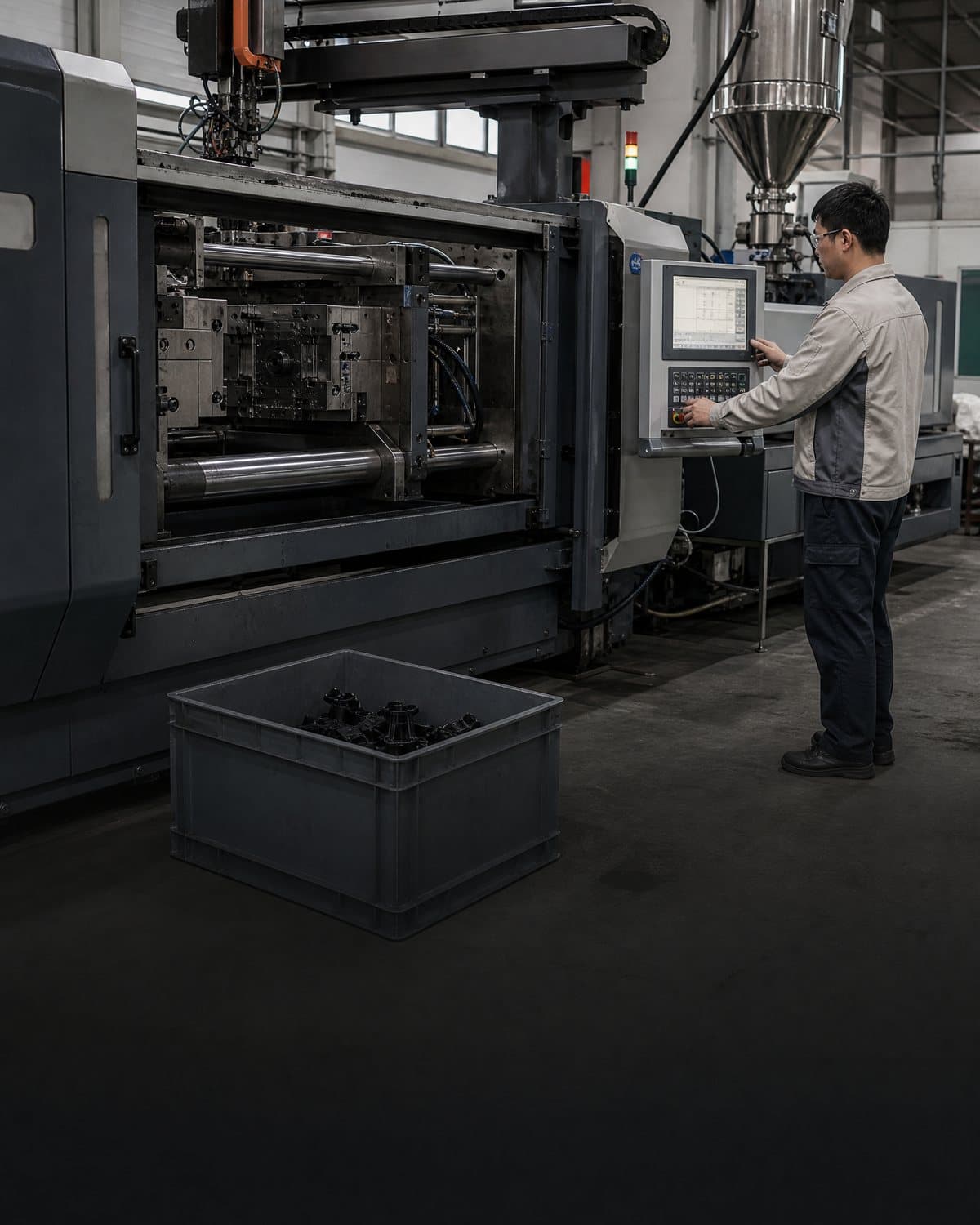
For hygroscopic or moisture-sensitive resins, drying evidence should be tied to the material lot and the molding window. Agree the approved drying instruction with the resin supplier or process owner: temperature, time, equipment or hopper identity, start and end, exposure limits after drying, and what happens after an interruption. The correct values depend on the grade and equipment; buyers should not impose one generic temperature or time across nylon, PC, PET, PBT, TPU or other materials. Resin supplier processing guidance should be the starting point, with the final control method documented for the programme.[4][5]
Ask what is actually recorded. A temperature setpoint alone may not show that the material reached the intended condition. Depending on risk and the agreed process, evidence can include dryer status, material loading and unloading times, hopper or bin identity, moisture checks, alarm or interruption records, and disposition of material that exceeded the permitted exposure window. The record should also explain how opened bags, transferred material, regrind and mixed lots are labelled and controlled.
04
Segregate uncertain material before it becomes mixed inventory
Segregation is a physical and system control. Use clear status labels such as released, quarantine, rejected, rework or pending certificate review, and ensure the warehouse, production screen and shipping record use the same status meaning. Keep unapproved or suspect lots separated from released material by location, container, system block or a combination appropriate to the risk. A red tag without a transaction block can still allow an accidental issue; a software block without practical physical separation can still allow a mix-up.
Define how partial bags, purge material, regrind, masterbatch, colour concentrates and line clearance residues are handled. Mixing may be technically acceptable in some programmes, but it must be an approved recipe or instruction with a traceable input list. If a material change, supplier change, regrind change or drying deviation occurs, identify the affected work order and hold route before restarting. The supplier should be able to explain how it prevents an unreviewed lot from being silently blended into a released one.
| Event | Immediate containment | Buyer evidence to request |
|---|---|---|
| Certificate missing or inconsistent | Place material and affected output on hold pending review. | Certificate comparison, lot scope, disposition and approver. |
| Dryer alarm or exposure-time breach | Identify material and run window; stop, isolate or assess per instruction. | Alarm record, moisture or process assessment and release decision. |
| Wrong grade, colour or supplier lot suspected | Stop issue and segregate material and potentially affected parts. | Inventory search, work-order link, quantity scope and correction. |
| Mixed or unlabelled container found | Quarantine container; do not infer identity from appearance. | Container history, reconciliation, test need and disposition. |
| Customer complaint or field signal | Preserve samples and records; define affected lots and shipments. | Trace matrix, containment notice, investigation and corrective action. |
05
Design recall readiness around a searchable trace matrix
Recall readiness is not a claim that a recall will never be needed. It is the ability to move from a material or process concern to a bounded population and a controlled decision. Build a trace matrix that can query forward from resin lot to work order, cavity or machine context, finished-goods lot, shipment and customer destination, and backward from a part or shipment to the relevant input and production records. The required level of granularity should reflect product risk, contractual requirements and applicable market obligations.
Run a tabletop exercise before launch or at an agreed interval. Select a hypothetical resin-lot concern and ask how long it takes to identify the affected production window, inventory, shipped quantities, open orders, retained samples, inspection evidence and decision owners. A useful exercise exposes gaps in naming, retention, access permissions and cross-border communication without pretending to be a product-specific regulatory recall plan. Keep the outcome, actions and owner in the quality record.

Practical takeaway
Before you move
to the next review.
- The approved material list names resin grade, compound, colour, filler, recycled-content direction and permitted alternatives where applicable.
- Each received lot has a searchable supplier lot code, status, certificate or declaration route, quantity and receipt record.
- Drying, exposure, interruption and moisture-control records are linked to the material lot and molding window when relevant.
- Quarantine, segregation, regrind, partial-container and material-change rules are written into the process or quality agreement.
- A tabletop trace exercise can identify affected inventory, shipments, retained samples, records and decision owners without guesswork.
FAQ
Common questions
Is a resin certificate enough to establish traceability for molded parts?
No. A certificate can provide agreed evidence about a material lot, but traceability also needs a link from that lot to the molding run, finished-part or packaging lot, inspection or disposition record and shipment scope. The required certificate type and retention period should be written into the purchase and quality documents.
Should every molded part carry the resin supplier's full lot number?
Not necessarily. A readable part mark may be impractical or harmful to the design. A controlled abbreviated code can work if the supplier maintains a secure, searchable key linking it to the full material and production records, and if packaging and inventory controls preserve the link.
What drying records should a buyer request for nylon or other moisture-sensitive resin?
Request the approved grade-specific drying instruction and records that show the material identity, dryer or hopper, relevant temperature and time, exposure or interruption status, and any required moisture check or disposition. Do not assume one universal limit; confirm the method against the resin supplier's guidance and the agreed process.
Can regrind be used while maintaining material lot traceability?
Sometimes, but only under a defined and approved control. The record should identify the source and status of regrind, allowed proportion or recipe, segregation rules and the production lots in which it was used. A general statement that regrind is acceptable does not define the evidence or risk boundary.
How often should a supplier test recall readiness?
The interval should be proportionate to product risk, customer requirements and the supplier's quality system. Agree an initial tabletop exercise before launch or first release, then set a review cadence and trigger-based exercise for major system, site, product or traceability changes. Record the result and close identified actions.
References
Source material
- [1] International Organization for Standardization, “ISO 9001:2015 Quality management systems — Requirements.”
- [2] International Organization for Standardization, “ISO 13485:2016 Medical devices — Quality management systems — Requirements for regulatory purposes.”
- [3] International Organization for Standardization, “ISO 2859-1:1999 Sampling procedures for inspection by attributes.”
- [4] BASF, “Ultramid® Processing Data and Guidelines.”
- [5] Covestro, “Makrolon® Processing Data.”
- [6] U.S. Food and Drug Administration, “Investigations Operations Manual: Recall Procedures.”
This guide is general information for early procurement and engineering discussion. It does not replace product-specific DFM, qualification, validation, regulatory assessment or legal advice.