
Buyers should treat a molded-part nonconformance as a controlled shipment decision, not as a late negotiation. Put the affected lot on hold, identify every potentially affected part, compare the finding with the approved specification, and release nothing until the supplier provides proportionate inspection, disposition, and corrective-action evidence. A concession may be appropriate for a genuinely understood, low-risk departure, but it should be written, time-bound, and approved by the buyer’s authorized quality function.
Containment answers what is protected today. Root-cause work answers why it happened and how recurrence will be prevented. Do not let a promising explanation substitute for verified lot control.
01
H2: Contain the lot before discussing a shipment date
The first action is an identifiable hold on the suspect lot and clearly linked work in process or packed goods. The hold must prevent mixing or dispatch. Record the part number and revision, lot, quantity, failed requirement, defect, detection point, and owner. FDA educational material describes the core sequence as identification, documentation, evaluation, segregation, and disposition. [2]
Define exposure from records, not assumptions. For molded parts, trace resin or color batch, mold and cavity, press, date or shift, process change, secondary operation, packing batch, and shipment status. If records cannot separate conforming from suspect parts, the scope remains unresolved.

02
H3: Classify the finding by requirement and release risk
Start with the approved drawing, material requirement, appearance limit, sample, inspection plan, or contract clause. Separate a documented requirement from a late preference. Then assess the consequence for fit, function, assembly, safety, regulatory status, appearance, and downstream sorting. A hidden visual mark and an out-of-tolerance sealing surface should not follow the same route.
Set the critical-to-quality characteristics, lot definition, sampling rules, and release authority before production. The comparison below is a decision aid, not a universal acceptance plan.
| Quality finding | Supplier control expected | Buyer release risk | Evidence before decision |
|---|---|---|---|
| Cosmetic departure outside a stated non-critical zone | Hold, photograph, count, and segregate | May be low after intended use and cosmetic class are checked | Requirement reference, location, quantity, buyer disposition |
| Dimensional or functional result outside specification | Freeze the lot; identify cavity, time, and process scope | Unknown until fit or function and exposure are verified | Raw results, gauge method, traceability, and sort or reinspection evidence |
| CTQ, safety, regulatory, or material identity concern | Stop release and escalate | High; convenience concession is inappropriate | Risk assessment, traceability, test evidence, authorized disposition |
| Recurring defect or unbounded scope | Extend containment and investigate | High; a sample cannot prove unaffected product sound | Trend data, root-cause investigation, action plan, effectiveness check |
03
H2: Make injection molding inspection fit the decision
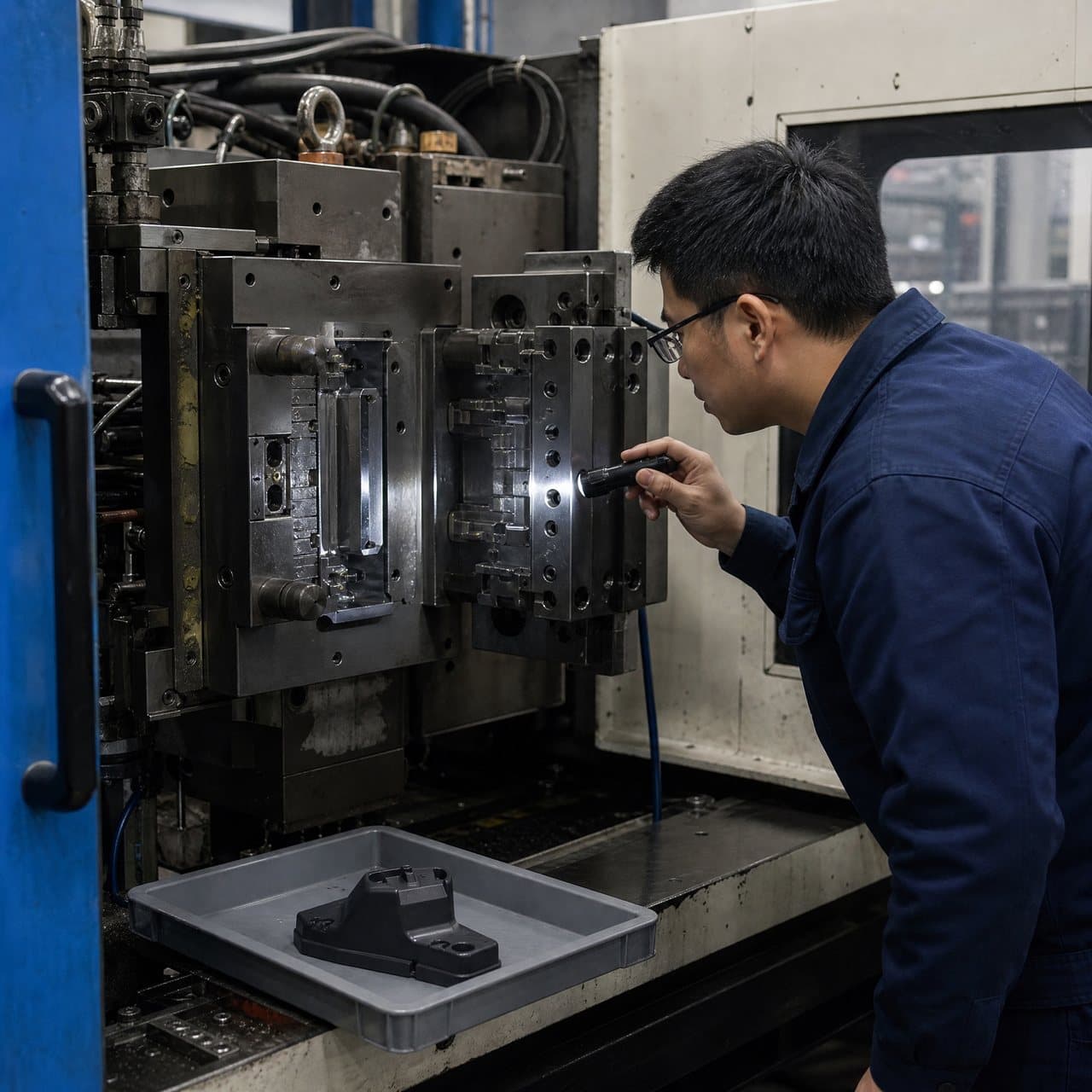
Inspection is useful only when it answers the release question. Request the approved plan and revision, sampling or sorting method, actual results, gauge or test method, and acceptance limits. Retain individual dimensional readings where required. For appearance, apply agreed lighting, viewing distance, surface zone, and reference sample. For assembly risk, require the relevant functional or fit check.
Random lot acceptance sampling can support a pre-defined accept or reject decision. NIST notes it decides whether a lot is likely acceptable; it does not estimate lot quality and is distinct from ongoing process quality control. [1] Do not retrofit a favorable sample after discovery. For a cavity-specific, intermittent, or critical defect, require a justified sort, functional check, or other method.
04
H3: Require defect analysis that separates correction from corrective action
A production adjustment or sort is containment or correction, not proof of cause. Request a concise injection molding defect analysis: problem statement, evidence, suspected mechanism, confirmation data, correction for held parts, corrective action, owner, due date, and effectiveness check. Depending on the failure, compare cavity location, settings, resin drying, mold condition, and before-and-after trial data.
ASQ distinguishes correction from corrective action, which removes the cause of a detected nonconformity to prevent recurrence. [3] Escalate recurring, severe, design-related, or process-related findings. A fully contained one-off still needs a recorded rationale.
05
H2: Control rework and concessions rather than normalizing exceptions
Rework needs an approved method, traceability, and reinspection against the original requirement. If it changes a surface, dimension, material condition, insert retention, or performance characteristic, assess whether further testing or approval is required. Record the reworked quantity, method, result, and disposition.
A concession is a buyer decision to accept a defined departure, not unilateral supplier release. Name the requirement, affected quantity or lots, rationale for intended use, needed labeling or communication, expiry, and approver. An informal message or promise to repair a mold later is not release evidence. Repeated concessions require a control review.
06
H2: Release shipment only through a documented gate
Before dispatch, reconcile quantity produced, held, scrapped, reworked, released, and open. Match released quantity to packing records and labels. The release package should include the nonconformance number, disposition, inspection results, defect-analysis status, concession if any, and release authority. This is especially important when cross-border transit makes reversal difficult.
Do not release if the requirement is unclear, traceability is broken, evidence does not represent the scope, rework is unverified, or an authorized approver has not accepted a required deviation.
07
H2: Procurement checklist before approving shipment
Use this checklist with the purchase order, quality agreement, and part-specific inspection plan. For new programs, ask suppliers how they document holds, segregation, traceability, and evidence.
08
H2: Put the release rules in the RFQ
For an RFQ covering custom molded plastic parts, provide the current drawing and revision, CTQs, cosmetic zones, material and color requirements, inspection evidence, lot definition, traceability, sampling or sorting rules, rework limits, and concession authority. Ask the supplier to identify unclear acceptance points before production.
Request a quote with the part files and intended release evidence. InjeForm can review RFQ documentation, while the buyer retains authority for requirements, deviations, and shipment acceptance.
Practical takeaway
Before you move
to the next review.
- Open a numbered record and hold the affected lot before shipment authorization.
- Confirm the exact unmet drawing, specification, sample, or inspection-plan requirement.
- Bound affected quantity by lot, cavity where relevant, process window, packing batch, and shipment status.
- Review raw inspection or functional-test evidence that represents the risk.
- Reconcile produced, held, scrapped, reworked, released, and open quantities.
- Approve rework or a concession in writing with scope, risk, expiry, and authority.
- Require corrective action and an effectiveness check for recurring, severe, or unbounded defects.
FAQ
Common questions
Can a supplier ship parts with a cosmetic defect?
Only if it is within approved criteria or the buyer grants a documented concession after checking zone, use, quantity, traceability, and recurrence.
Is an AQL result enough to release a nonconforming molded lot?
Not automatically. It must follow the agreed lot, method, and limits, and may be inadequate for an intermittent, cavity-specific, functional, or critical defect.
What should be in an injection molding quality report after a defect?
Ask for the requirement, defect, affected scope, containment, raw results, disposition, root-cause evidence, action owner, due date, and effectiveness status.
When should a buyer reject rather than request rework?
Reject or hold when the part cannot be verified to the original requirement, traceability is missing, risk is critical, or no authorized deviation supports use.
Who may approve a deviation before shipment?
Name the buyer’s authorized technical or quality representative in the quality agreement. A supplier proposal or informal message is not approval.
References
Source material
- [1] NIST/SEMATECH e-Handbook of Statistical Methods: What is Acceptance Sampling?
- [2] U.S. Food and Drug Administration: Nonconforming Product transcript
- [3] ASQ Ask the Experts: Nonconformance Versus CAPA Requests
This guide is general information for early procurement and engineering discussion. It does not replace product-specific DFM, qualification, validation, regulatory assessment or legal advice.