
Can an injection molded product be designed for recycling and practical disassembly? Often, but not from a resin label or a recycling symbol alone. The product architecture, exact grade and additives, part count, joints, inserts, coatings, labels, contamination risk, identification method and available recovery route must be considered together. The suitable solution depends on resin, geometry, tooling, machine, environment, forecast volume and the customer’s written requirements.
For overseas OEM, procurement, quality, engineering and product teams, treat recyclability as a sourcing and approval question. Define the intended end-of-life route, decide which assemblies must be opened, and ask suppliers to show how the molded design supports that route without weakening required performance. A recommendation to use one polymer family or one fastener type is not a universal requirement; the product specification, applicable market rules and validation plan control the release decision.
Buyer rule: approve a recycling route and a disassembly method together. Require evidence on the actual molded design, joint system, material grade and use environment before making a recyclability claim.
01
Define the recycling and disassembly outcome before the RFQ
Start by stating what the product must become after use. The requirement may be reuse, repair, replacement of a subassembly, manual separation of materials, mechanical recycling of a defined plastic fraction, or controlled treatment through a customer or regional system. These outcomes are different. A product that can be opened for service is not automatically recyclable, and a single-polymer enclosure is not automatically accepted by every collection or sorting stream.
Record the product boundary and the decision owner. Identify which molded parts, elastomers, metals, adhesives, coatings, labels, electronics and residues are included. For each item, specify whether separation is required, recommended or out of scope. RecyClass explains that design-for-recycling guidance is evaluated against compatibility with a given recycling stream, so the buyer should name the intended stream and geography rather than request an unqualified universal claim.[1]
At RFQ stage, provide the latest assembly CAD, exploded view, material direction, service intent, expected opening events, annual volume, operating environment and customer market. Ask the supplier to return a marked-up architecture showing material families, joint locations, tool implications and unresolved assumptions. The product owner should approve the end-of-life objective before detailed tool design begins.

02
Choose materials and interfaces for compatibility, not labels
A recyclable injection molded part requires a specific resin and formulation decision. Polymer family, grade, reinforcement, recycled content, colorant, flame retardant, elastomer, insert and surface treatment can affect performance and the downstream route. Request the exact producer, grade, revision, additive or filler state, color system, processing guidance, regrind policy and permitted alternatives. A generic statement such as PP, ABS or engineering plastic is not sufficient approval evidence.
For a product intended to yield a clean plastic fraction, compare compatible parts against mixed-material construction. A same-family snap cover may simplify separation, while a metal insert can improve service or load performance but adds a separation step. Adhesive, overmolding, paint, labels and soft-touch layers may be functionally necessary, yet they can change sorting, grinding or contamination risk. Require a documented trade-off rather than banning every secondary material by default.
The supplier should identify where material choice affects flow, shrinkage, warpage, weld-line strength, ejection, tool wear, drying, conditioning and inspection. These are engineering dependencies, not reasons to promise a result. Require representative molded samples and application-relevant testing when the proposed grade, recycled content or joint material differs from the baseline.
| Architecture choice | Potential benefit | Recycling or disassembly risk | Buyer evidence request |
|---|---|---|---|
| Single polymer family for major molded shells | May simplify sorting and material identification. | Compatibility still depends on grade, additives, color, contamination and local route. | Exact grades, additive declaration, stream assumption and trial or protocol evidence. |
| Mechanical fasteners | Can support service access and controlled separation. | Adds parts, torque variation, loss risk and labor or automation steps. | Fastener bill of materials, opening sequence, torque window and disassembly work instruction. |
| Integral snap features | Can reduce separate hardware and enable tool-assisted opening. | May fatigue, break during opening or prevent repeated service. | Retention, opening-force, cycle, temperature and end-of-life separation evidence. |
| Adhesive or permanent welding | May improve sealing, stiffness or tamper resistance. | Can block separation or introduce a less-compatible fraction. | Joint material, failure mode, separation method and application-specific justification. |
03
Design the molded geometry and tool around the opening sequence
Disassembly planning should be visible in the part design. Show the intended access direction, tool clearance, hand or fixture contact points, fastener removal order, snap release locations and the condition of parts after opening. A part can be moldable yet impossible to open without destroying the housing or damaging a recoverable component. Treat opening force, retention, rattle, sealing, impact and tamper resistance as product requirements where they apply.
Geometry changes also affect tooling. A service window, screwdriver pocket, weakened break line or release feature may require draft, ribs, bosses, lifters, slides, inserts, revised parting lines or extra inspection. Ask for a DFM review that links each feature to its function, mold operation, risk and evidence. Do not assume that a two-piece assembly has lower total cost: added assembly, tolerance stack-up, sealing, inventory and end-of-line inspection may outweigh a simpler mold.
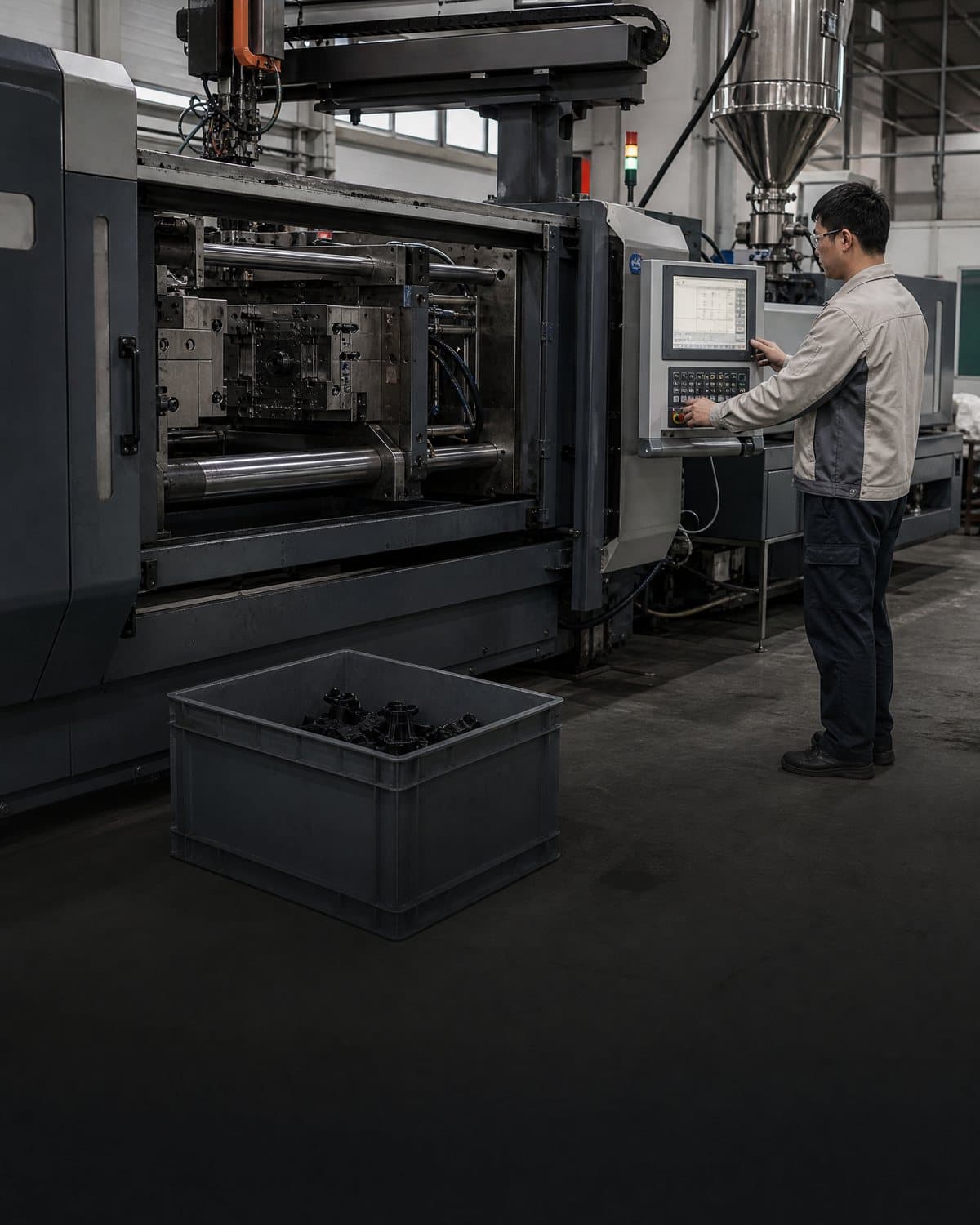
Where the product is intended for automated separation, request an interface concept early. Define orientation, gripping surfaces, fastener access, force limits and allowable fragments. Where manual disassembly is intended, define the tool, sequence, training assumption and time basis without promising a universal labor result. Confirm the final opening method on production-intent samples and record any part damage that would change the recycling route.
04
Build evidence gates into supplier selection and validation
Make recyclability and disassembly deliverables part of the quotation, not an informal sustainability promise. At the concept gate, require a material map, end-of-life route, joint comparison, open assumptions and a preliminary risk register. At the DFM gate, require the parting-line and ejection review, material and additive confirmation, disassembly sequence, tooling consequences and proposed tests. At the sample gate, identify the exact resin lot or grade, molded-part revision, assembly condition and inspection method.
Quality should approve evidence against the drawing and product specification, not against a supplier’s generic capability statement. Request dimensional and visual results for interfaces, opening-force or retention results where specified, material identification, relevant environmental conditioning, contamination controls and traceability. If a recycling protocol, customer standard or market claim is required, identify the owner, method, laboratory or evaluator and acceptance basis before testing begins.
Use a formal change-control gate after approval. Advance notice and re-approval may be required for resin producer or grade, additive, recycled-content source, colorant, insert, adhesive, coating, label, joint geometry, tool, molding site, subcontractor, process window or disassembly method changes. The level of retesting depends on the risk and customer requirement. A supplier’s ‘equivalent’ designation is not approval without documented comparison.
| Approval gate | Minimum buyer decision | Supplier evidence to request |
|---|---|---|
| Concept and RFQ | End-of-life route, service intent, material boundaries and required versus recommended features. | Architecture mark-up, assumptions, material map and joint options. |
| DFM and tool release | Approved geometry, opening sequence, exact material direction and inspection plan. | DFM report, tool concept, flow or risk analysis where justified, and test matrix. |
| Pilot or PPAP-equivalent review | Production-intent samples meet functional, dimensional and documented separation criteria. | Part records, material traceability, assembly and disassembly results, deviations and corrective actions. |
| Routine supply and change control | No unapproved change undermines the approved route or evidence. | Change notices, lot records, substitution declarations and refreshed tests when triggered. |
05
Compare practical routes and avoid overclaiming
A recyclable product architecture is a balance between product life, serviceability, production risk and end-of-life handling. A permanently joined shell may give the best sealing or tamper resistance. A screw-fastened shell may improve repair and separation but add cost, parts and assembly controls. A snap-fit may reduce hardware while creating fatigue or opening-force questions. A modular design may simplify replacement but increase interfaces and tolerance stack-up. Compare the complete system against the customer’s use case rather than ranking one route as universally superior.
Do not convert design intent into a market claim without checking the applicable jurisdiction and evidence. The European Commission describes rules covering packaging composition, manufacturing and recoverability, with an objective for packaging placed on the EU market to be recyclable in an economically viable way by 2030; that packaging framework does not automatically certify a non-packaging product or every molded component.[2] ISO 11469 describes a generic identification and marking system intended to support later handling, recovery or disposal decisions, but a molded mark does not prove actual acceptance by a recycler.[3]
Before release, ask procurement, engineering, quality and product owners to sign the same decision record. It should name the approved resin and alternatives, joint architecture, intended disassembly route, evidence limits, customer obligations, target markets and change triggers. If the evidence is incomplete, state that the design is under evaluation. This is more defensible than promising universal recyclability, fixed cost, cycle time, tolerance, service life, compliance or certification.

Practical takeaway
Before you move
to the next review.
- Name the target end-of-life route, geography, product boundary and whether reuse, repair, separation or mechanical recycling is the actual requirement.
- Request the exact resin producer, grade, additives, reinforcement, color system, recycled-content position, processing guidance and approved-substitution rules.
- Review every joint, insert, coating, label and overmold for opening sequence, tool access, contamination risk, service intent and material separation evidence.
- Require supplier evidence at concept, DFM, sample and routine-supply gates, including traceability, application-relevant tests and documented deviations.
- Put resin, geometry, tooling, process, site, subcontractor and disassembly-method changes under written notification and re-approval rules.
FAQ
Common questions
Does using one recyclable plastic resin make an injection molded product recyclable?
No. A single resin family may simplify identification or separation, but actual recyclability depends on the exact grade and additives, product geometry, labels and inserts, contamination, sorting and processing capability, and the intended regional recycling stream. Ask the supplier to define the route and provide evidence for the finished design.
Which is better for disassembly: screws, snaps or adhesive?
There is no universal best joint. Screws may support controlled service access but add parts and assembly controls. Snaps may reduce hardware but need retention, fatigue and opening-force evidence. Adhesive or permanent welding may support sealing or tamper resistance but can hinder separation. Select against the product’s service, sealing, load, environment and end-of-life requirements.
Should a buyer require recycled content in every molded part?
Not automatically. Recycled content can support a customer objective, but the suitable percentage and source depend on grade availability, contamination controls, appearance, mechanical and thermal performance, regulatory or customer requirements, and the approved end-of-life route. Require a grade-specific declaration and qualification plan rather than a generic percentage claim.
What should a supplier submit before approving a recyclable molded design?
Request an architecture and material map, exact grade and additive information, DFM and tooling implications, disassembly work sequence, sample identification, relevant dimensional and functional results, material traceability, limitations of the evidence, and a change-control plan. The buyer should also define which market rules, customer standards or recycling protocols govern acceptance.
References
Source material
- [1] RecyClass, Design for Recycling Guidelines
- [2] European Commission, Packaging waste and Packaging and Packaging Waste Regulation
- [3] ISO Online Browsing Platform, ISO 11469: Plastics—Generic identification and marking of plastics products
- [4] U.S. Federal Trade Commission, Green Guides
This guide is general information for early procurement and engineering discussion. It does not replace product-specific DFM, qualification, validation, regulatory assessment or legal advice.