
Buyers should plan preventive care as a tool-specific operating agreement: name the asset and revision, establish a starting condition, set service triggers, define the evidence to retain, and decide who may approve corrective work. This gives injection mold maintenance a decision path before a production issue turns into an urgent commercial discussion; it is not a promise that a fixed interval will prevent every failure.
The plan should connect changes observed at the tool with the part characteristics that matter to the programme. For injection molding quality control, that means separating routine observations from part-specific acceptance, product validation and any regulatory decision. The appropriate scope depends on the part, resin and grade, tool design, production pattern, environment and approved requirements—not on a universal shot-count rule.
A maintenance interval is a review trigger, not a guaranteed tool-life or product-acceptance claim.
01
Set the maintenance basis before the first production release
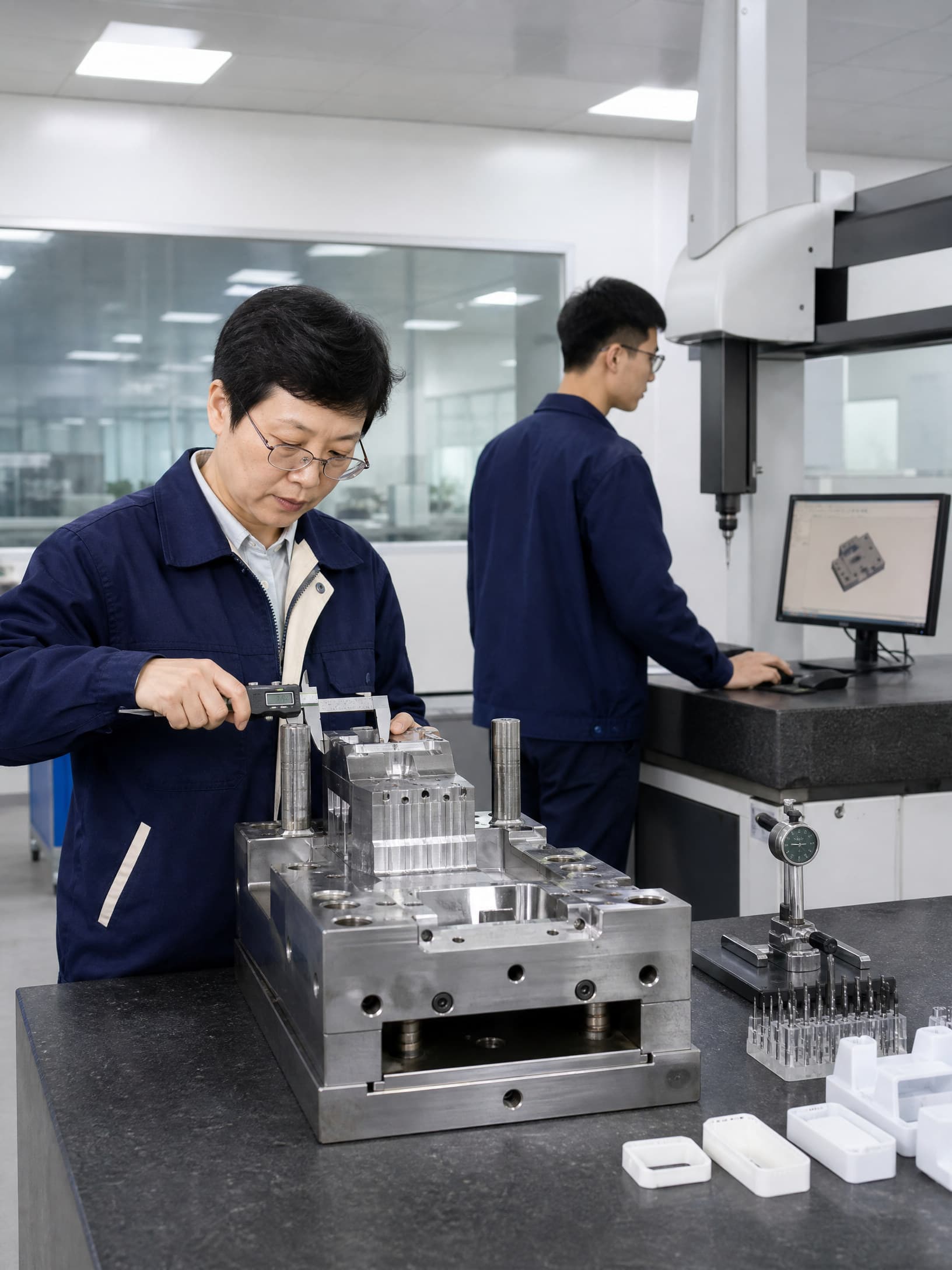
Start with a controlled tool record, not a generic service schedule. Identify the part and tool revisions, cavities or inserts, runner or hot-runner configuration, material and colour direction, planned demand pattern, approved cosmetic faces, critical interfaces and known handling limits. Add the baseline photographs, initial sampling or inspection references, open actions and the person who can interpret a change. This injection mold tooling record gives purchasing, engineering and operations the same reference when a symptom or service request is raised.
Then define what will trigger attention: a production count, elapsed idle time, a material or colour change, a part symptom, a leak, unusual ejection behaviour, a storage event or a documented incident. Do not treat any one trigger as sufficient by itself. Resins can leave different deposits, and maintenance guidance recommends inspecting areas such as runners, vents, sprues and gates while keeping records of inspections and anomalies.[4] The buyer's task is to agree which observations must be logged and when they require engineering review for this particular tool.
02
Use evidence-led triggers instead of a fixed calendar
A calendar can organise work, but it should not hide the reason for it. Ask the molder to propose a trigger matrix using the actual tool design and operating context. A high-cosmetic part, a tool with moving cores, a filled or deposit-prone resin, an extended unattended run and a long idle period can justify different review points. The point is comparability: a quote or maintenance scope should state what is checked, why the check is due, what evidence is retained and what happens if the check finds a concern.
Part symptoms are useful signals, not automatic proof of a tool defect. DME explains that inadequate venting can contribute to short shots, poor surface appearance or weak weld lines; its guidance also distinguishes routine wiping of vented ejector pins from cleaning or replacing clogged porous vents.[2] Record the lot, resin, machine context and symptom alongside the tool finding. That history helps the team decide whether to inspect a vent, investigate process conditions, review the part requirement or take another part-specific action.
| Trigger type | Buyer should define | Evidence and next decision |
|---|---|---|
| Start or end of a run | Visible checks, responsible role and features that must be observed before release or storage. | Dated tool ID, condition note and any exception routed to the named owner. |
| Planned preventive review | The tool-specific basis: production exposure, material, mechanism complexity and prior history. | Inspection record, work performed, parts used and revised next-review trigger. |
| Part or process symptom | Which symptoms require a hold, sample review, tool inspection or engineering escalation. | Linked lot, material, process context, photographs and disposition. |
| Idle storage or restart | Preservation steps, authorised condition check and the restart evidence required. | Storage record, restart findings and any agreed sample or inspection decision. |
03
Specify inspection evidence and decision rights
The maintenance specification should name the evidence, not simply request that a tool be “serviced.” A practical record can capture the date, tool and part revision, reason for work, observations, photographs where useful, areas cleaned or inspected, consumables or components used, unresolved risks and approver. Where injection mold ownership is held by the buyer, that record is also the basis for understanding the condition of the asset; it does not give either party authority to alter controlled geometry without agreement.
Keep component-specific instructions with the asset. For example, Mold-Masters identifies its hot-runner manual as part of the documentation package and directs users to the bill of materials and general assembly drawing when ordering spare parts; its maintenance procedures also require appropriately trained personnel.[3] Ask for the relevant manuals, spare-part identifiers and settings records at handover. A general plan should not override the component supplier's safety, disassembly or reassembly instructions.

04
Separate routine care, repair and a controlled design change
Write three distinct routes. Routine care covers the agreed inspection, cleaning, lubrication or preservation tasks that do not change the approved design. An injection mold repair restores a worn, damaged or malfunctioning feature, but still needs a documented symptom, scope, cost authority and record of the work. A design change alters a controlled feature, material path, surface, vent, gate, cooling route, insert or mechanism and should require written technical approval before work begins, except under a pre-agreed emergency procedure.
For every route, identify who may diagnose, who may authorise expenditure, which replacement parts are pre-approved, when photographs or samples are required and who accepts the restart condition. If a change could affect a critical dimension, appearance, assembly, material contact or product claim, the post-work review is part-specific. General maintenance guidance cannot establish regulatory compliance, product validation or final customer acceptance; those decisions belong to the applicable product requirements and validation plan.
05
Plan storage and restart as a defined handoff
A mold storage service should describe more than a rack location. Agree how the tool is identified, cleaned and dried; which surfaces receive preservation; how cooling connections, loose items and documents are controlled; what condition checks occur during idle time; and who authorises restart. Meusburger notes that corrosion protection is important for storing and transporting molds and dies, and that a clean surface helps avoid trapping corrosive residues beneath protection.[1] The specific preservative, storage environment and refresh interval remain choices for the tool, location and material risks—not generic compliance requirements.
Before requesting a quote or engineering review, send the tool record, proposed trigger matrix and approval map with the CAD and quality inputs. Ask prospective parties to identify scope gaps, excluded components, expected evidence and any part-specific restart recommendation. That makes the response easier to compare and gives a buyer a concrete starting point for an engineering discussion. For a written review of an open maintenance scope, contact info@injeform.com.

Practical takeaway
Before you move
to the next review.
- Create a revision-controlled tool baseline with asset ID, inserts, components, condition evidence and the responsible decision-makers.
- Set review triggers from the tool's production exposure, resin, mechanisms, prior history, idle periods and observed part symptoms.
- Require a service log that links the reason for work, observations, actions, replacement parts, open risks and approvals.
- Separate pre-authorised routine care from repair and from any geometry or performance-affecting change that needs written approval.
- Define storage preparation, condition checks, restart evidence and the part-specific decision path before the tool is idle.
FAQ
Common questions
Should a preventive plan use a fixed number of shots?
A count can be one trigger, but it should not be the whole plan. The suitable basis depends on the tool, resin, mechanisms, production exposure, symptom history and idle periods. Ask for the rationale, inspection scope and escalation path rather than treating a generic number as a guarantee.
What should a maintenance record show a buyer?
It should make the tool and revision identifiable, state why the work occurred, record observations and actions, identify parts or consumables used, preserve relevant evidence and show the decision on any open issue. The level of detail should be agreed in the service scope.
Does a tool restart require product revalidation?
Not automatically. A restart check, sample review or broader validation should be determined by the product's controlled requirements, the work performed and the potential effect on critical characteristics. Decide that part-specifically with the relevant engineering and quality owners.
References
Source material
- [1] Meusburger, “Corrosion protection for your moulds and dies.”
- [2] DME, “Venting Solutions.”
- [3] Mold-Masters, “Sprint User Manual.”
- [4] Slide Products, “Preventive Maintenance Guide for Injection Molding.”
This guide is general information for early procurement and engineering discussion. It does not replace product-specific DFM, qualification, validation, regulatory assessment or legal advice.