
The evidence needed for medical injection mold validation is a controlled, approved package showing that the specified mold, molding equipment and process can repeatedly produce acceptable parts under defined conditions. In practice, buyers should expect documented IQ, OQ and PQ where the process or its outputs require validation, linked to design inputs, acceptance criteria, material and lot records, inspection results, deviations, approvals and change control—not a certificate or a first-article report alone.[1]
Quote-oriented CTA model: send the controlled drawing and CAD revision, resin direction, intended use, CTQs, target market, cleanliness requirement, expected volume and requested validation deliverables. Ask for a scoped quotation that separates tooling, sampling, qualification runs, inspection, documentation and any cleanroom or packaging work. This guide is general information; it does not replace the legal manufacturer’s validation plan, quality agreement, regulatory assessment or legal advice.
01
Start with the validation boundary
Before asking for IQ/OQ/PQ, define what is being validated. A mold is not automatically the finished medical device, and a supplier’s press qualification is not automatically validation of the customer’s finished product. The boundary may include mold design and build, the press and auxiliary equipment, resin drying and handling, molding parameters, inspection, cleaning, assembly, packaging or sterilisation. The product owner or legal manufacturer should state which outputs are critical to safety, performance, fit, cleanliness or release.
FDA describes process validation as objective evidence that a process consistently produces a result or product meeting predetermined specifications. It also distinguishes processes whose results cannot be fully verified by later inspection and test; those processes require validation with a high degree of assurance.[1] That risk-based decision should drive the evidence request. A dimension that can be fully inspected may need a defined measurement record, while a process characteristic that cannot be completely verified may need a validated operating window and ongoing monitoring.
02
What IQ, OQ and PQ should show
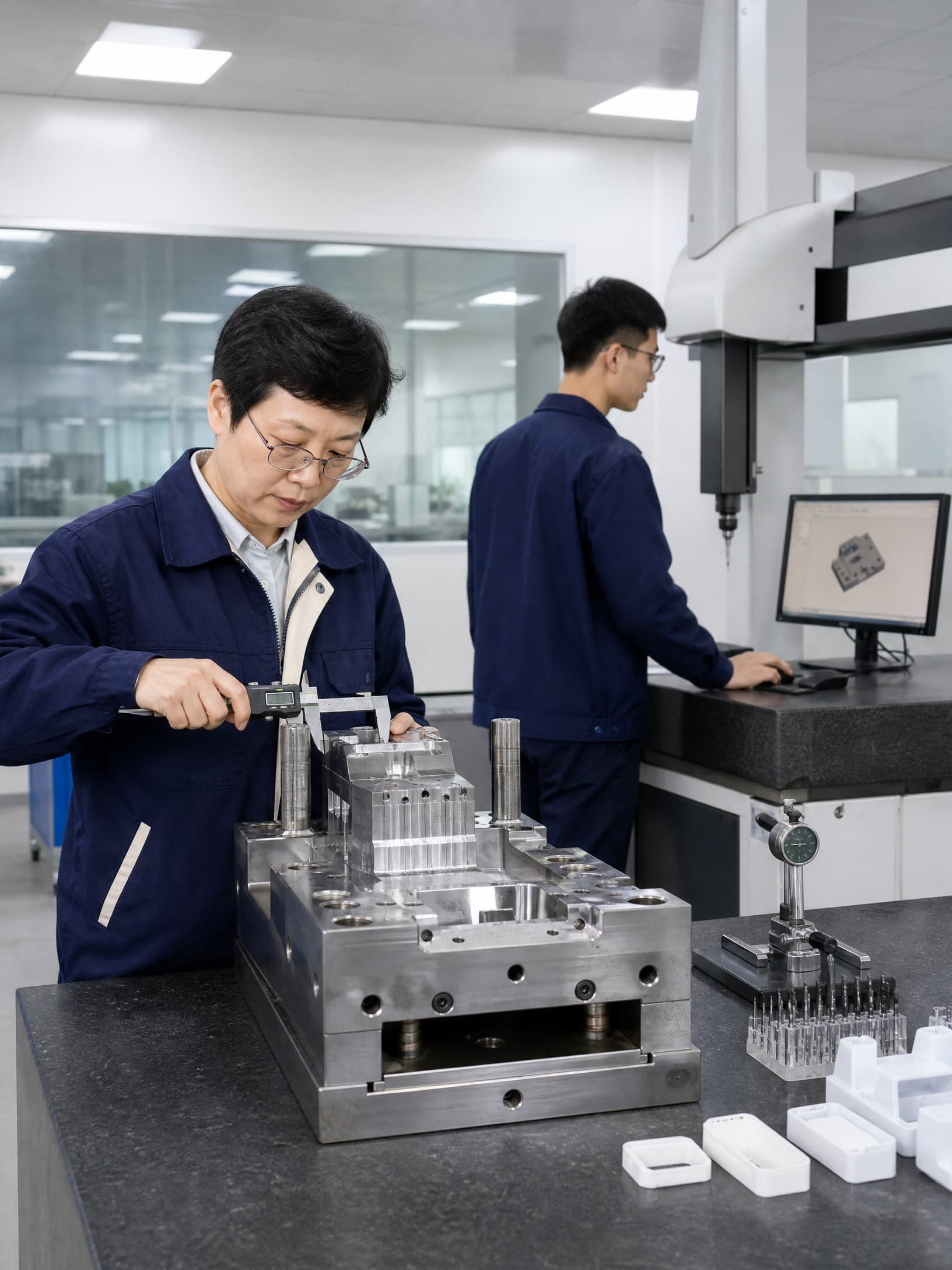
Installation Qualification (IQ) should establish that the specified equipment and supporting items are installed as intended. For molding, that can include the press identity, mold identity and revision, utilities, software or recipe controls where relevant, calibration status, maintenance status, safety features, material-handling equipment and environmental conditions. IQ is evidence of configuration and readiness; it does not prove that acceptable parts are produced.
Operational Qualification (OQ) challenges defined process parameters and limits. The protocol should explain the selected variables, ranges, worst-case or challenge conditions, material handling, inspection methods, failure responses and acceptance criteria. Performance Qualification (PQ) then demonstrates repeatable output under normal production conditions, using approved material and trained personnel. FDA guidance says PQ should consider actual manufacturing conditions, acceptable product, repeatability and longer-term stability.[1] The protocol and report should identify runs or samples by rationale rather than relying on an unexplained number.
| Evidence stage | Buyer should look for | What it does not prove by itself |
|---|---|---|
| IQ | Approved equipment and mold configuration, installation checks, calibration and maintenance records, utility and software checks. | That the process window makes conforming parts. |
| OQ | Challenge protocol, parameter ranges, limits, worst-case conditions, test methods, deviations and approvals. | That routine production remains stable over time. |
| PQ | Normal production conditions, approved material, trained operators, defined sampling, results and repeatability rationale. | Finished-device regulatory clearance or clinical performance. |
| Release and monitoring | Batch or lot identification, inspection results, review status, deviations, trend monitoring and change triggers. | That future changes need no assessment or revalidation. |
03
Build traceability from resin to released part
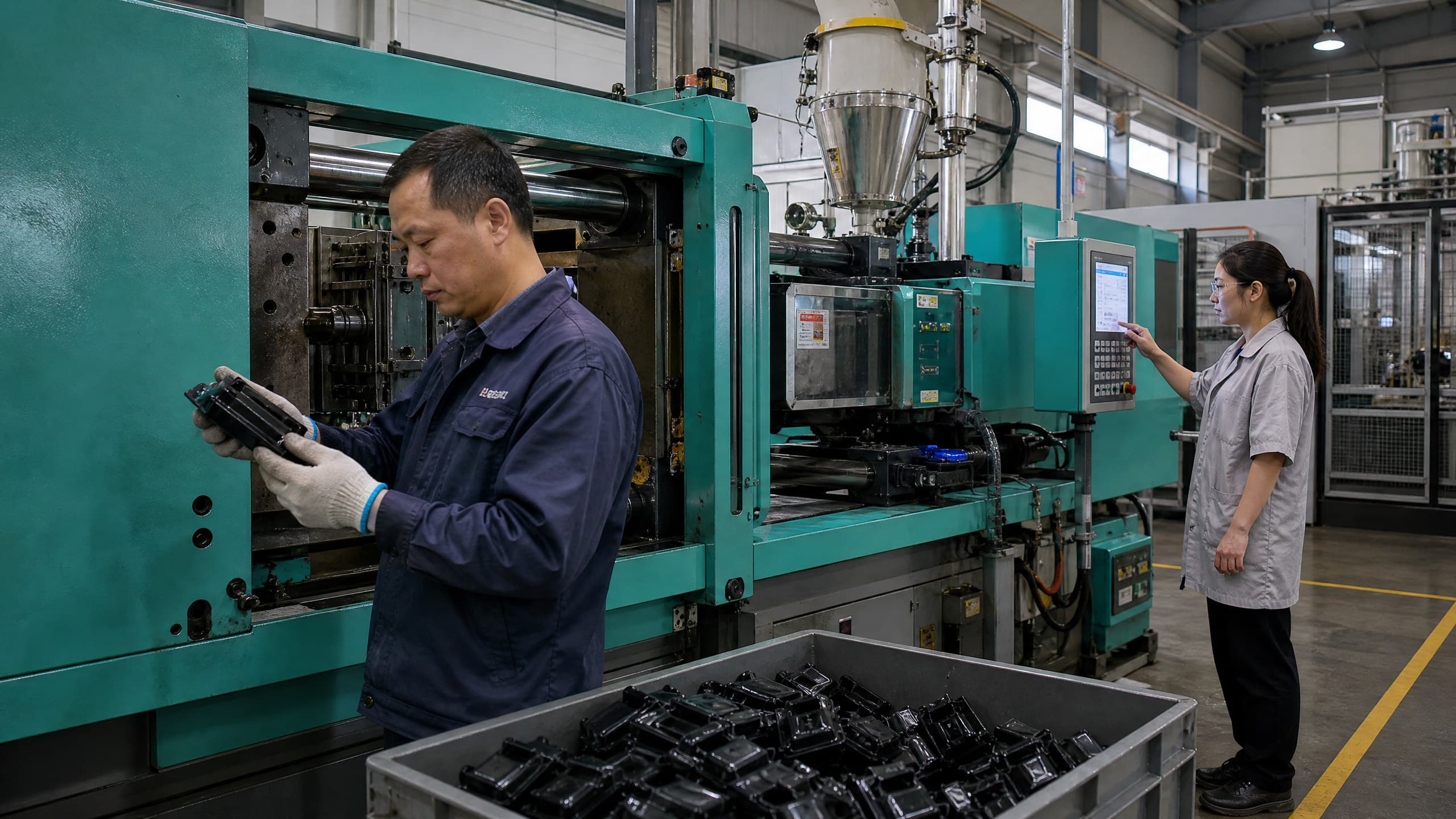
A useful validation package lets an auditor or buyer move in both directions: from a released lot back to its resin, mold, machine, recipe, operator, inspection and disposition records, and from a process change forward to the affected parts and customers. Agree the identifiers before trials begin. These may include drawing and mold revisions, resin manufacturer and grade, resin lot, colourant or additive lot where relevant, machine and cavity identification, date and shift, parameter or recipe revision, sample numbering, inspection equipment and approval status.
For U.S.-regulated finished-device manufacturers, the current QMSR incorporates ISO 13485:2016 by reference, and the eCFR adds requirements for records and identification, including UDI or other device identification as applicable.[2][3] A component molder should not promise to own the customer’s finished-device records. Instead, the quality agreement should state which manufacturing and inspection records the molder creates, how long they are retained, how records are protected, and how nonconforming material, deviations and changes are communicated.
04
Treat cleanroom evidence as a defined control, not a badge
Cleanroom relevance depends on the product boundary and contamination risk. If molded parts enter a controlled assembly, fluid path, sterile barrier or other cleanliness-sensitive process, define the required environment, transfer route, gowning, cleaning, packaging and handling controls. Ask for the applicable room classification, qualification or monitoring records, environmental limits, excursion procedure and evidence that the part is protected after molding. ISO 14644-1 addresses classification of air cleanliness by airborne particle concentration in cleanrooms and clean zones.[4] That classification does not by itself demonstrate bioburden control, sterility, endotoxin control, product cleanliness or suitability for a particular device.
The request should distinguish room evidence from product evidence. A cleanroom certificate or particle-count report can support an environmental-control claim, but it does not replace part-specific cleaning, packaging, microbial, chemical or functional validation when those are required by the product and process. Conversely, a supplier may produce a non-sterile molded component in a controlled area without owning the customer’s sterilisation validation. Put the boundary, handoff condition and acceptance criteria in the purchase specification or quality agreement.
05
Keep Europe, the United States and other markets in their proper lanes
Regulatory obligations attach to the device, economic operator and market role, not simply to the fact that a mold makes a medical-looking part. FDA states that QMSR applies to finished device manufacturers intending commercial distribution, while some accessories can themselves be finished devices.[2] In the European Union, MDR Article 10 requires manufacturers to establish and maintain a quality management system proportionate to device risk and type, covering areas such as supplier control, risk management, production and change management.[5] A component supplier can support those controls, but should not represent its mold validation file as EU conformity assessment or U.S. market authorization.
For a Middle East programme, confirm the importing country’s authority, registration route, local representative and customer quality requirements rather than assuming that an EU or U.S. file transfers unchanged. The same evidence may be useful across markets, but its ownership, format, language, retention period and approval route may differ. Ask the legal manufacturer to approve the validation master plan, acceptance criteria, deviations, final report and change or revalidation triggers. FDA guidance specifically notes that process changes, negative quality trends, design changes, site transfers and changed applications can require review and revalidation where appropriate.[1]
Practical takeaway
Before you move
to the next review.
- The validation boundary identifies the mold, press, auxiliaries, material handling, inspection and any downstream steps in scope.
- IQ, OQ and PQ protocols state approved inputs, acceptance criteria, responsible approvers, deviations and report requirements.
- Traceability links drawing and mold revisions, resin and process records, cavities, samples, inspection results and disposition.
- Cleanroom classification, monitoring, transfer, packaging and product-cleanliness responsibilities are separated and documented.
- The quality agreement assigns regulatory ownership, record retention, change notification and revalidation decisions for each target market.
FAQ
Common questions
Is a first-article inspection report enough to validate a medical injection mold?
Usually not. First-article results can verify selected dimensions and appearance at a point in time, but they do not by themselves establish equipment installation, a challenged process window, repeatability under normal conditions, traceability or ongoing monitoring. The required package depends on the product and process risk.
Does every medical molded part require IQ, OQ and PQ?
Not necessarily. The product owner should use a documented, risk-based decision tied to whether outputs can be fully verified and to applicable quality-system requirements. Where validation is required, the protocol should explain why each qualification stage and evidence set is appropriate.
Can a cleanroom classification prove that molded parts are sterile?
No. Cleanroom classification concerns environmental airborne particle cleanliness. It does not, by itself, prove sterility, bioburden, endotoxin, chemical cleanliness or product suitability. Those claims require product- and process-specific evidence where applicable.
Who owns the validation report: the molder or the device manufacturer?
Ownership should be stated in the quality agreement. The molder may execute and retain agreed equipment, process and inspection records, while the legal manufacturer typically controls the finished-device validation strategy and regulatory file. Responsibilities can vary by contract and market role.
What should change control trigger after validation?
Any change to the mold, cavity, resin, machine, software, process window, site, inspection method, packaging or intended use should be screened for impact. The responsible quality function should decide whether verification, partial qualification or revalidation is needed and document that decision.
References
Source material
- [1] U.S. Food and Drug Administration, Process Validation (CDRH Learn).
- [2] U.S. Food and Drug Administration, Quality Management System Regulation (QMSR).
- [3] Electronic Code of Federal Regulations, 21 CFR Part 820—Quality Management System Regulation.
- [4] International Organization for Standardization, ISO 14644-1:2015—Cleanrooms and associated controlled environments—Part 1.
- [5] European Union, Regulation (EU) 2017/745 on medical devices, Article 10.
- [6] International Organization for Standardization, ISO 13485—Medical devices.
This guide is general information for early procurement and engineering discussion. It does not replace product-specific DFM, qualification, validation, regulatory assessment or legal advice.