
Large-part injection molding can be a practical route for equipment shrouds, access doors, operator panels, protective covers, machine housings and larger enclosures when the production volume and geometry justify dedicated tooling. The procurement decision is not simply whether a supplier owns a large press. It is whether the released part, resin, tool concept, machine envelope, handling plan and acceptance evidence work together for the intended application.
For an overseas OEM, the most useful supplier comparison turns the term "large part" into controlled inputs: maximum part envelope, projected area, expected shot size, wall and rib layout, cosmetic zones, fastening and sealing interfaces, environment, annual demand, logistics constraints and customer-specific approval criteria. These are requirements to define. Suggestions such as a different gate arrangement, split line or resin grade are engineering recommendations that should be reviewed and approved against those requirements before tooling release.
Buyer decision point: do not treat machine tonnage, a generic material family or a first-shot sample as evidence that a large enclosure or cover is production-ready. Require a part-specific capability review and approve the defined evidence at each gate.
01
What makes an enclosure or equipment cover a large-part molding program?
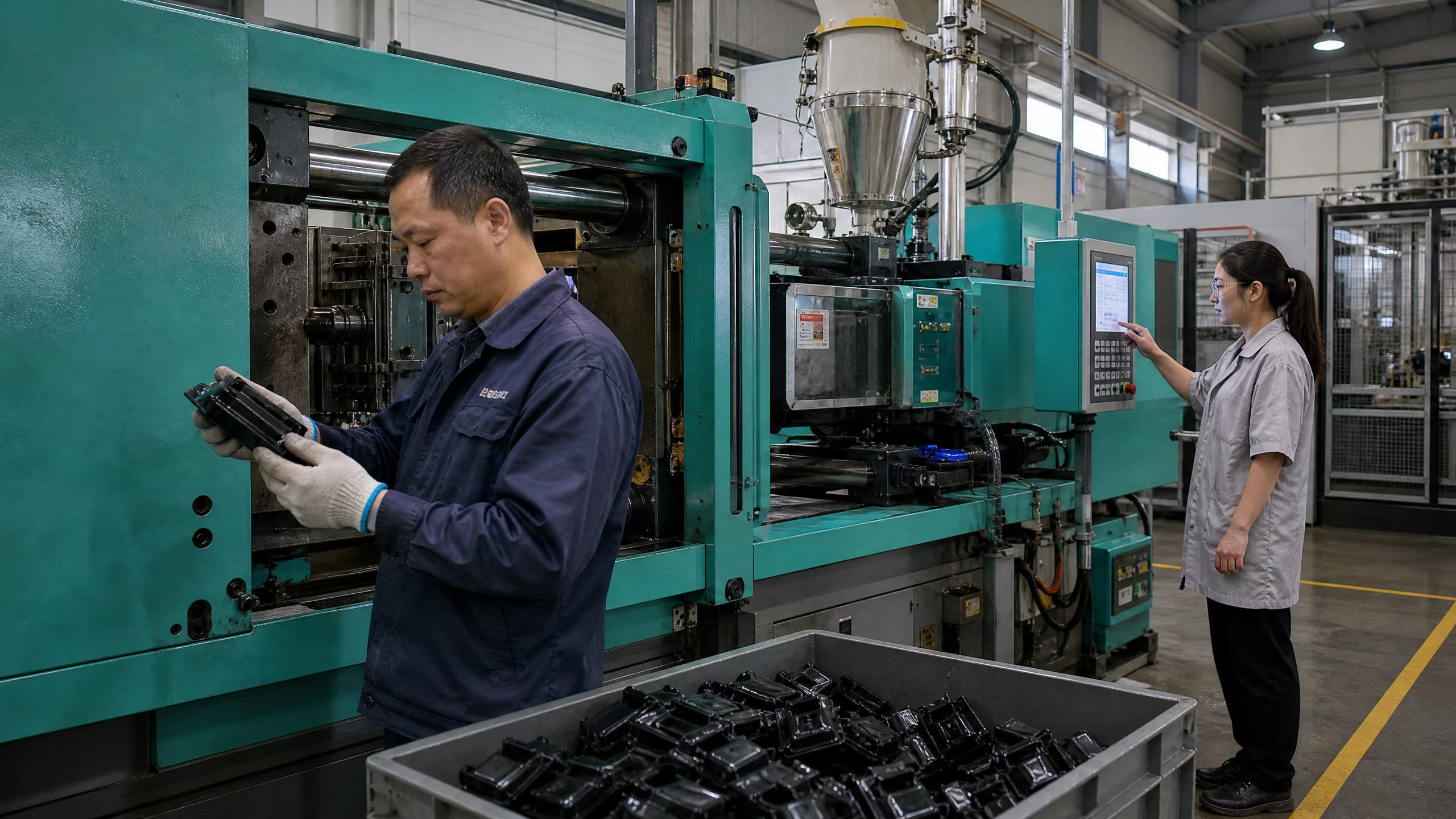
There is no single dimensional threshold that makes a component a large injection-molded part. For sourcing purposes, size is a system question. The supplier should review the part’s projected area and anticipated cavity pressure for clamp-force planning, the resin volume and runner system for injection-unit capacity, and the tool’s overall envelope for platen, tie-bar, mold-height, opening-stroke and ejection limits. Part mass alone does not resolve those questions.
Large exterior faces and long flow paths can magnify risks that may be modest in a smaller housing: differential shrinkage, visible flow patterns, weld-line placement, sink opposite local mass, distortion after ejection, and damage during handling or packing. The likely outcome depends on resin grade, wall transitions, ribs and bosses, gate and cooling design, texture, color, mold construction, processing window and the customer’s definition of an acceptable part. A broad claim that a particular press or resin will prevent these effects is not a substitute for a part-specific review.
Before requesting a binding quotation, provide a controlled CAD model and drawing revision, maximum envelope, expected material direction, annual and order volumes, target markets, service and assembly needs, critical interfaces, visible surfaces, packaging intent and any product-standard obligations. Ask each bidder to state the assumptions it used. If the supplier proposes changes to part split, wall construction, fastening or material, record them as recommendations rather than silently absorbing them into the quoted scope.
02
Select resin by service condition, not by a generic enclosure label
A cover that shields indoor automation equipment may prioritize appearance, stiffness, impact at its service temperature and attachment performance. An outdoor access cover may additionally need a defined weathering, moisture, temperature and chemical-exposure basis. An electrical enclosure can introduce flame, electrical, ingress, temperature or end-product obligations. These are product requirements owned by the buyer and product team; a molder can help assess process implications, but should not be asked to infer unshared compliance obligations.
Use a named resin grade or a controlled approval path, rather than a resin family alone. Published data sheets are useful for preselection, but a test-bar value may not represent the final molded geometry, weld line, color formulation, fiber orientation, conditioning or service exposure. ASTM D648, for example, describes a controlled flexural-load test and cautions against using its data as a general prediction of elevated-temperature endurance. Treat requested test data as supporting evidence with a stated method and condition, not as an automatic field-performance guarantee.
The comparison below is a sourcing screen, not a material prescription. Confirm the actual grade, additive package, color, recycled-content policy where applicable, wall section and validation plan with the product owner and resin supplier before release.
| Application driver | Possible material direction to evaluate | Evidence and trade-off to put in the RFQ |
|---|---|---|
| Indoor equipment cover with broad visible faces | ABS, PC/ABS or another approved appearance-oriented grade may be screened | Request grade and color identification, cosmetic standard, proposed gate/ejector zones, texture direction and sample review conditions; check chemical-cleaning and temperature exposure if relevant. |
| Outdoor shroud or access cover | ASA, weatherable PC-based or other application-approved compound may be screened | State UV, moisture, temperature, impact and color-retention requirements. Ask for the actual exposure method, duration, conditioning, property-change criteria and whether the evidence applies to the specified grade and color. |
| Stiff panel, machine guard or load-bearing housing feature | Mineral- or glass-reinforced resin, or a redesigned unfilled resin section, may be considered | Review anisotropic shrinkage, warpage, surface appearance, gate orientation, fastener loads and post-mold flatness against the actual datum scheme; reinforcement is not automatically the lower-risk choice. |
| Electrical or heat-adjacent enclosure | A grade selected against the product’s specified electrical, flammability and temperature needs may be considered | Identify the applicable end-product requirement and thickness, color, use condition and traceability expectations. Verify any material recognition or listing directly for the exact use case; do not equate a material data-sheet claim with finished-product approval. |
03
Turn a large cover design into a tool-and-machine feasibility decision
A useful feasibility review begins with the supplier’s marked-up part model. Ask it to identify the proposed parting line, draw directions, gate locations, runner concept, venting approach, cooling concept, ejection and handling points, slide or lifter needs, and areas that are likely to affect cosmetics or distortion. The review should also show where the supplier needs a decision from the buyer, such as an allowed weld-line zone, a hidden gate location, a texture change or a revised interface datum.
The nominated production machine should be evaluated against the complete mold and process, not only a stated clamp-force label. Request the machine or machine-range assumptions for platen and tie-bar clearance, mold height, opening and ejector stroke, injection-unit shot range, nozzle interface, resin drying and handling, robot or operator access, utilities and part-removal protection. A supplier may reserve or change equipment as its schedule develops, so the production machine, or the criteria for an equivalent machine, should be controlled before production approval.
Where flatness, seam alignment, sealing land continuity, latch function or assembled fit is critical, agree the datum structure and measurement approach before the first trial. ISO 20457 addresses possible manufacturing tolerances and acceptance conditions for molded plastic parts, but product-specific functional requirements still need to be defined. Do not copy a universal dimensional tolerance into the RFQ; establish only the critical dimensions, allowable condition and acceptance method that the product requires.

04
Compare large-part molding suppliers on evidence, scope and change control
A comparable quotation separates one-time and recurring scope. It should identify the controlled part revision, resin grade or proposal, tool concept and cavity count, runner approach, expected operations, inspection scope, packaging basis, volume bands, delivery terms and quoted exclusions. Quote comparisons become unreliable when one response includes texture, inserts, assembly, inspection fixtures, protective packaging or engineering changes that another leaves undefined.
Request evidence that is specific enough to examine, not a general statement of capability. Useful items may include an annotated DFM, a tool layout, a machine-fit and shot-capacity review, a preliminary molding and cooling plan, a quality plan for critical features, a cosmetic-control plan, sample inspection format, resin traceability method and a proposed schedule with approval gates. The buyer should determine which items are contract requirements. A supplier’s preferred practice can be evaluated as a recommendation, but it should not replace the buyer’s specification.
For overseas programs, also make change control auditable. Define who may approve a substitution of resin grade, colorant, mold steel, gate location, surface finish, machine, inspection method, production site or subcontracted operation. Require written notification and the agreed level of requalification before a change is implemented. This protects both cost control and the integrity of the approved sample.
05
Use approval gates that prove the part is fit for the intended assembly and market
A first-shot part can expose molding issues, but it does not by itself demonstrate that a large enclosure or cover is ready for routine supply. Establish a gate plan before tool build. Gate 1 can release the DFM and tool-design decisions; Gate 2 can accept the initial trial evidence and correction plan; Gate 3 can approve production-intent samples against dimensional, appearance, assembly and application-specific requirements; Gate 4 can release routine production after the agreed documentation and packaging checks are complete. Names and sequence may vary, but the decision authority and evidence should be explicit.
At the production-intent gate, examine parts made with the approved resin grade, color and relevant process route. Review critical dimensions to the agreed datums, mating part fit, closures or fasteners, seal interfaces where applicable, surface acceptance under defined viewing conditions, label or insert retention, and packing protection. If the application is outdoor, heat-adjacent, electrical or otherwise regulated, the product owner should separately specify the validation and regulatory evidence required. ASTM G154 is a practice for operating fluorescent UV exposure equipment; it requires the exposure conditions and the method for evaluating property changes to be specified. A generic claim of "UV tested" therefore is not enough for release.
Maintain a release file that links the part revision, tool identification, cavity if applicable, resin lot or grade, approved master sample or visual standard, inspection results, deviations, disposition and shipment authorization. Define what constitutes a material change, tool repair, process change or out-of-spec result, and whether it triggers notification, containment, resampling or revalidation. This is a recommendation for traceable decision-making; the final documentation set should be proportionate to the product risk and customer requirements.

Practical takeaway
Before you move
to the next review.
- Issue the controlled 3D model and drawing with maximum envelope, critical datums, material direction, volume bands, visible-surface map, assembly interfaces and environmental requirements.
- Ask each supplier for an annotated DFM, proposed tool layout, machine-fit and injection-unit review, gate and cooling rationale, handling plan and a list of technical assumptions or exclusions.
- Compare quotations on the same revision, resin grade, cavity proposal, secondary operations, inspection scope, packaging basis, delivery term and change-control assumptions.
- Freeze an approval plan that names the evidence, samples, acceptance criteria, approvers and disposition path for DFM, first trial, production-intent sample and routine-production release.
- Require written approval before any material, color, tool, gate, texture, machine, site, process, inspection or packaging change that the buyer has designated as controlled.
FAQ
Common questions
How do I know whether one large molded cover is better than several smaller molded pieces?
Compare the total system, not only tool size. A one-piece cover can remove seams and assembly steps, but may demand a larger machine, more difficult handling, longer flow paths or stricter control of distortion. Multiple pieces can simplify molding or shipping but add joints, fasteners, sealing interfaces and assembly risk. Ask the supplier to compare the proposed concepts against your functional, cosmetic, service, logistics and volume requirements using the released CAD and stated assumptions.
What machine information should a large-part injection molding supplier provide?
Request a part-specific review of projected-area and clamp-force assumptions, mold envelope versus platen and tie-bar clearance, mold height, opening and ejection stroke, injection-unit usable shot range, nozzle interface, resin handling, utilities and part-removal method. The supplier does not need to disclose every proprietary process setting, but it should provide enough evidence for the buyer to judge whether the proposed tool and machine are compatible.
Can a UL-recognized or flame-rated resin automatically make an enclosure compliant?
No. Material recognition, ratings and test data may be relevant inputs, but they do not automatically establish that a finished enclosure meets a particular market or end-product requirement. Applicability can depend on the exact grade, color, thickness, use condition, construction and the governing product standard. The product owner should identify the applicable requirement and obtain the appropriate verification for the finished product.
Which evidence should be approved before paying for production tooling?
At minimum, agree the released part revision, material direction, visible and functional requirements, critical datums, supplier DFM, proposed parting and gate strategy, tool concept, machine-capacity basis, inspection plan, sample stages, approval authority and change rules. The required detail should increase where the cover affects safety, sealing, outdoor durability, electrical performance or critical equipment fit.
References
Source material
- [1] ISO 20457:2026 — Plastics moulded parts — Tolerances and acceptance conditions
- [2] ASTM D648 — Deflection Temperature of Plastics Under Flexural Load
- [3] ASTM G154 — Operating Fluorescent UV Lamp Apparatus for Exposure of Materials
- [4] UL Solutions — Understanding the UL 746 Series of Standards
This guide is general information for early procurement and engineering discussion. It does not replace product-specific DFM, qualification, validation, regulatory assessment or legal advice.