
A buyer cannot responsibly manage an injection molding lead time as one number. The route from an RFQ to usable production parts contains decisions that may be sequential, parallel or conditional: technical clarification, DFM agreement, commercial release, tool design, material readiness, mold manufacture, trials, sample review, corrective work, production release, packing and transport. Any one of those can become the real constraint. A stated date is therefore useful only when its start condition, included scope, dependencies and approval gates are explicit.
This guide gives product, purchasing and quality teams a way to build a decision-led plan without assuming a particular factory, tool material, shipping lane, certification or regulatory pathway. It is relevant whether the buyer is in Europe, North America or the Middle East, but the final contract, import route, product rules and customer-specific evidence must be verified for the actual programme. The objective is not to promise speed. It is to make the critical path, the buyer-owned inputs and the supplier-owned commitments visible early enough to manage them.
Do not ask only, “When can we have parts?” Ask which controlled baseline starts the clock, what each milestone proves, what can run in parallel, and whose written decision allows the next commitment.
01
Plan the injection molding schedule as a chain of release conditions
Separate an inquiry date from a release date. An RFQ may support an early technical review or budgetary response, but not authorize tool design, material purchase or a trial booking. State the start condition for each workstream in writing: for example, a controlled CAD and drawing revision, DFM closure, purchase-order release or tool-concept approval. If the inputs differ, record separate starts rather than one headline date.
Identify the decision gates that control progress. A gate is where an authorized person accepts a baseline, risk or change—not a meeting that happened or a sample that shipped. Common gates are RFQ clarification, DFM alignment, tool-design release, trial review, sample disposition, production release and shipment release. The supplier may own the work to reach a gate; the product owner normally retains product-requirement and acceptance authority.
Treat dates as conditional until the prior release conditions close. NIST identifies supply-chain mapping, risk assessment and visibility on planning as practical ways to manage disruption and reduce critical-path lead time. Map dependencies first, then place buffers and escalation routes at the decisions that can actually move the plan.
| Planning layer | Question the buyer should answer | Evidence that closes the layer | What can otherwise move the date |
|---|---|---|---|
| Part baseline | Which CAD, drawing, material direction, cosmetic zones and interfaces apply? | Named revision and written treatment of open points. | A late geometry, resin, appearance or mating-part decision. |
| Tooling decision | What tool concept, cavity assumption, feed, ejection and change authority are in scope? | Approved tool-design release or explicitly agreed release condition. | A DFM trade-off or commercial assumption that has not been accepted. |
| Trial and evidence | What must the sample demonstrate, how will it be measured, and who decides? | Sample plan, acceptance criteria, method and decision owner. | A sample that is physically available but cannot support the intended release decision. |
| Supply release | What constitutes approved production, pack-out and shipment readiness? | Documented release status and agreed logistics hand-off. | Unclosed deviations, unavailable material, incomplete packing information or freight assumptions. |

02
Make mold build lead time an auditable supplier assumption
A tool-build estimate is not the total programme duration. It may cover mold design, machining, bought-in components, fitting, assembly and first-trial preparation, yet exclude buyer approvals, material readiness, trial rework, inspection, secondary operations or dispatch. Ask where the estimate starts and ends, which inputs are buyer-furnished, and what events trigger replanning. The result should be an assumption register, not an optimistic single date.
Ask which part characteristics make the route uncertain without demanding a premature guarantee. Draft, texture, wall transitions, undercuts, inserts, functional interfaces, special resins and cosmetic limits can affect tool split, gating, ejection, machining, polishing, venting and trial strategy. Published guidance notes that draft depends on material, wall depth, texture, shrinkage and ejection. Request marked-up views explaining the proposed decision and effect.
Put customer-supplied inserts, labels, mating components, fixtures and appearance standards on the same plan. A molded sample may be available while the programme is not ready to judge it. Parallel work is useful only when the team has agreed which open decisions can safely be revisited and which would cause repeated work.
03
Build a production tooling timeline around parallel work and protected decisions
A credible production tooling timeline separates linked work from work that can proceed in parallel. The part package, DFM review, tool-design discussion, inspection plan, material-document request, packaging development and logistics preparation can overlap. Each lane still needs a stated input, owner, output and rule for handling an input change.
At each review, ask whether a slip or change prevents the next buyer decision or shipment. If yes, give it an owner, a due condition and an escalation route. Often-hidden critical items include unanswered supplier questions, resin approval, a functional-measurement fixture, a customer-supplied assembly component, or label information for pack-out. Record the issue, effect, containment, decision owner and latest decision point—not only a traffic-light status.
For formal launch programmes, use gated-planning discipline without presuming every part needs an automotive submission. AIAG’s APQP overview covers sourcing, change management, risk mitigation, metrics and gated management. Those ideas help test readiness, but do not define the evidence, approval authority or compliance obligation for a particular part. Verify customer, contract and product requirements.
| Workstream | Can it begin before tooling is finished? | Minimum input to start | Buyer control point |
|---|---|---|---|
| DFM and tool-design alignment | Yes, before manufacture begins. | Controlled enough geometry, functional priorities and material direction to review assumptions. | Approve or reject the proposed change, concession or open-risk route. |
| Inspection and sample plan | Yes, before the first trial. | CTQs, datums or functional checks, sample purpose and acceptance decision. | Confirm the method is suitable for the feature and release question. |
| Material and appearance preparation | Often, subject to the agreed material and colour decision path. | Approved grade or a documented process for resolving the grade and appearance reference. | Authorize any alternative or state that the work remains provisional. |
| Packaging and transport planning | Yes, before production release. | Destination, handling constraints, Incoterm, label content and pack-out needs. | Validate the commercial and import assumptions with the relevant parties. |
| Routine production commitment | Only when the agreed release boundary is satisfied. | Approved production baseline and disposition of meaningful open items. | Issue the documented release, conditional release or hold decision. |
04
Define injection molding sample timing by decision purpose, not trial labels
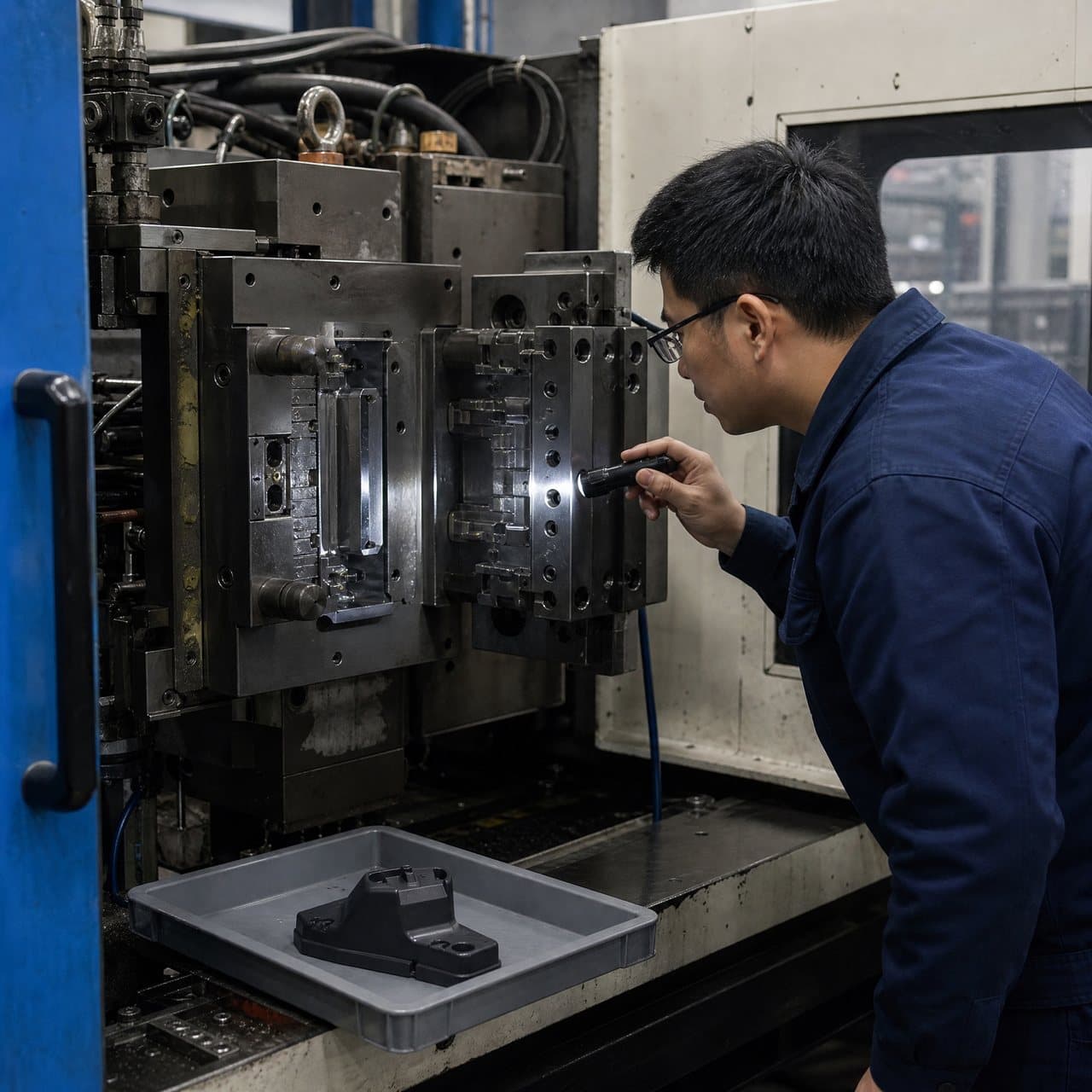
Injection molding sample timing should answer a decision question, not simply mark the arrival of parts. Trial labels vary between suppliers. State whether samples are for mold-function review, dimensional learning, cosmetic evaluation, assembly fit, process evidence, customer submission or a production-representative release. Tie the purpose to revision, material, tool context, inspection condition and reviewer so a trial part is not mistaken for a production approval sample.
Before the trial, agree how feedback is recorded and how changes are classified. A change to the product definition, tool, process, material, measurement method, appearance reference or assembly method can have a different owner and schedule effect. Agree sample identity, accompanying data, shipping documents and response deadline before shipping. For a remote review, put transit, customs handling where relevant and internal reviewer availability on the plan.
Measurement evidence must fit the decision. NIST defines metrological traceability as a documented unbroken calibration chain that contributes to measurement uncertainty, and cautions that traceability alone does not assure fitness for purpose. Verify the feature, datum or fixture, sample condition, method and report format needed to judge the real interface.
05
Use injection molding supplier communication to control changes through delivery
Set a communication rhythm based on decisions, not status volume. Name an operational contact on each side and the technical, commercial, quality and shipping decision owners. Agree revision control, time-zone window, cadence while a gate is open, response expectation for blocking questions and escalation path. Maintain one action-and-assumption log with an identifier, affected baseline, owner, required decision, due condition and disposition. Log proposed changes separately before implementing them.
For European, North American and Middle East supply chains, align logistics and documentation early but do not generalise legal conclusions across markets. Confirm the contracting party, Incoterm, importer or consignee roles, labels, customs-classification support, packing requirements, trade-control screening where applicable, and language or record needs with appropriate specialists. For EU products within applicable harmonised rules, manufacturers must prepare technical documentation before placing the product on the market. That is product-specific: a molder’s report or material record is not automatically a technical file.
Close with two commitments: production release and delivery. The first authorizes a stated part, material, tooling and acceptance status for routine supply. The second commits quantity, packaging, shipping terms and hand-off. Keeping them separate prevents a sample acceptance from becoming a shipping promise. Reconfirm both when design, material, tool, quality requirement or forecast changes.

Practical takeaway
Before you move
to the next review.
- Name the controlled part baseline and the exact event that authorizes each workstream to start.
- Request a supplier assumption register that separates tool work, sampling, approval, production, packaging and delivery scope.
- Create a gate log with decision owner, required evidence, open risks and an escalation path for every date-driving item.
- Define each requested sample by decision purpose, revision, material, tool context, measurement method and written disposition route.
- Verify destination-specific contract, import, logistics and product-documentation responsibilities before turning a production release into a shipment commitment.
FAQ
Common questions
When does injection molding lead time actually start?
There is no universal start event. The buyer and supplier should state the start condition for each workstream, such as a controlled RFQ package, DFM closure, purchase-order release or tool-design approval. A quoted period is interpretable only when its start event, included work and exclusions are documented.
Should a buyer book production before samples are approved?
It depends on the agreed risk and release boundary. Some preparatory work may run in parallel, but a buyer should distinguish provisional capacity or material planning from authorization to make routine supply. Record what can proceed, what remains at risk, and which sample evidence or decision is required before a production commitment becomes firm.
How should an overseas buyer allow for shipping and approval time?
Put supplier dispatch, transport, customs handling where applicable, receipt, internal sample review and final release in separate schedule lines with named owners. Confirm the Incoterm, consignee or importer roles, shipping documents and destination requirements for the actual transaction. Do not assume a supplier’s tool or trial date includes these buyer-side and cross-border dependencies.
References
Source material
- [1] National Institute of Standards and Technology, “Supply Chain Management.”
- [2] National Institute of Standards and Technology, “Metrological Traceability.”
- [3] Automotive Industry Action Group, “Advanced Product Quality Planning (APQP).”
- [4] European Commission, Your Europe, “Preparing technical documentation.”
This guide is general information for early procurement and engineering discussion. It does not replace product-specific DFM, qualification, validation, regulatory assessment or legal advice.